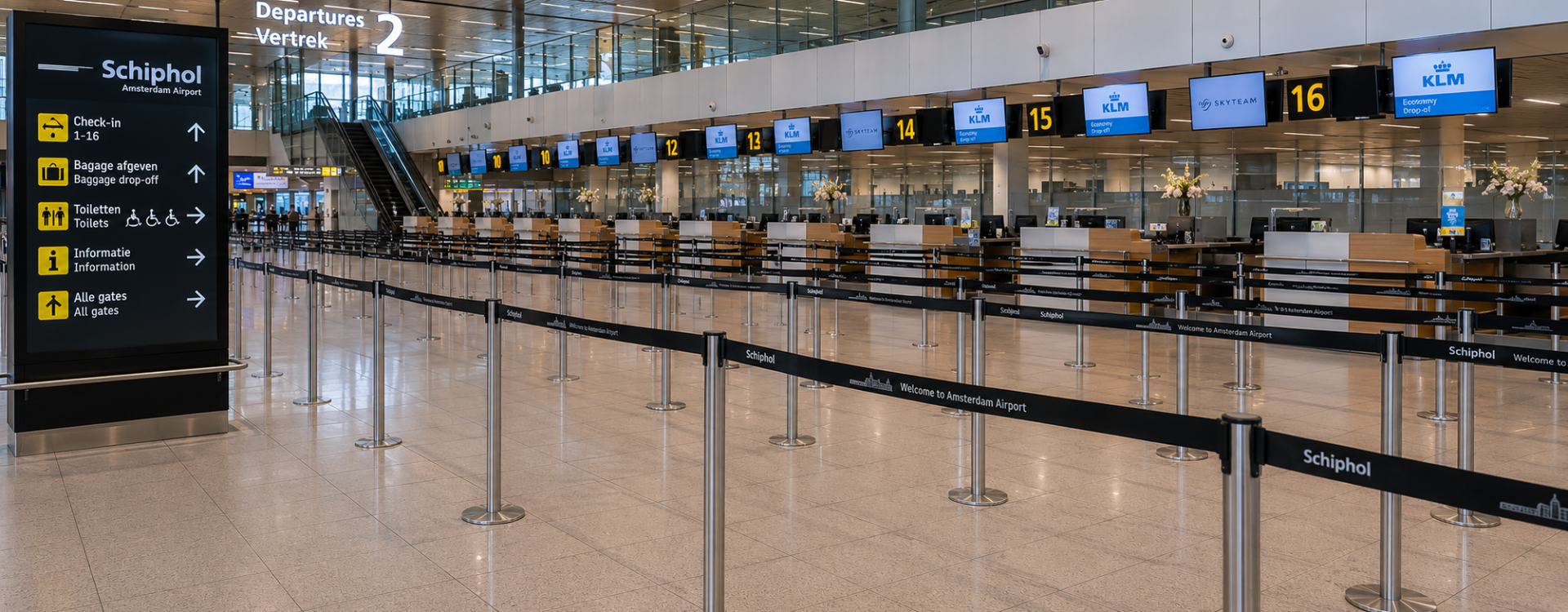
Airport traffic flow managementGuidance posts at the airport: 5 practical use cases
In a demanding environment such as an airport, managing passenger flows is a matter of safety and operational efficiency. Discover how guidance posts address five critical situations encountered daily by airport teams.
Each year, major European airports welcome tens of millions of travellers. Managing these human flows smoothly, securely and clearly represents a permanent challenge for operators, airlines and service providers. Retractable strap guidance posts - also known as guidance posts or queue barriers - constitute one of the most versatile pieces of equipment to meet this challenge. Far from being mere accessories, they structure space, guide passengers, secure sensitive areas and contribute to the professional image of the site. This article presents five practical use cases, drawn from the operational realities of airport terminals, to help operations managers, security managers and B2B buyers identify the solutions best suited to their needs.
Why do airports have specific requirements for flow guidance?
Before detailing the use cases, it is useful to recall what distinguishes an airport from another public-facing site. Several factors make flow management particularly complex in this context:
- Density and variability of flows: peak congestion can be extreme during holiday periods, strikes or cascade delays, then drop sharply during off-peak hours.
- Diversity of users: regular experienced passengers, foreign tourists unfamiliar with the local language, people with reduced mobility, families with young children - all coexist in the same space.
- Security requirements: certain areas can only be accessed by authorised personnel. Physical flow separation is a regulatory obligation, not merely an organisational choice.
- Speed of reconfiguration: a terminal can change its allocation within hours according to aircraft rotations. Guidance equipment must be able to be moved, reconfigured or stored quickly.
- Brand image: an international airport is the first and last impression a traveller takes away from a country or city. The aesthetics of equipment directly participate in this image.
These constraints explain why guidance posts used at airports must meet robustness, flexibility and customisation criteria far superior to those required in other commercial environments.
💡 Good to know: in the airport sector, a distinction is generally made between "landside" areas (accessible to everyone) and "airside" or "restricted area" zones (subject to access control). Guidance posts are used in both types of spaces, but with different specifications.
Use case No. 1 - Organising check-in queue management at counters
The check-in hall is one of the most frequent points of tension in a terminal. Dozens of counters, several airlines, queues that form spontaneously with no apparent logic: without an appropriate guidance system, confusion quickly sets in and creates frustration, conflicts between passengers and operational slowdowns.
The single serpentine queue: an operational standard
The most efficient configuration - and the most widespread in major airports - is the single serpentine queue. It consists of creating a zigzag corridor using posts linked by retractable straps, which then feeds several counters. This system offers several major operational benefits:
- Elimination of the "wrong queue" effect: each passenger accesses the next available counter, which reduces the sense of injustice and tensions.
- Floor space optimisation: the serpentine configuration allows a large number of people to be accommodated in a limited area.
- Real-time adaptability: it is enough to add or remove posts to lengthen or shorten the queue according to demand.
- Immediate clarity for passengers, including those who do not speak the local language.
The retractable strap posts are particularly well suited to this use thanks to their quick connection system between units, their non-slip weighted base and strap length generally between 2 and 3.5 metres, sufficient to cover standard spacing between counters.
Management of priority queues and fare classes
Airlines often distinguish between several service levels: business class passengers, loyalty programme members, families with young children, passengers requiring assistance. Creating dedicated corridors with strap posts allows these distinctions to be physically materialised without requiring expensive fixed barriers to install and remove. Straps in different colours or personalised in the airline's colours further enhance the clarity of these separations.
Use case No. 2 - Securing security screening areas
Security screening points (SSP) are regulated areas where flow management must simultaneously meet safety, fluidity and regulatory compliance requirements. It is one of the most demanding environments for guidance equipment.
🔒
Channelling towards scanners
Posts guide passengers towards detection scanners and baggage screening conveyors whilst preventing any unauthorised circumvention.
⚡
Swift reconfiguration
In the event of an incident or closure of a lane, posts can be moved within seconds to redirect flow towards an alternative lane.
🚧
Separation of incoming/outgoing flows
In certain configurations, posts delimit distinct corridors to avoid any crossing between passengers who have cleared screening and those still waiting.
The mechanical robustness of posts is crucial here. Weighted bases must withstand accidental impacts without tipping over, and straps must support repeated tension without deteriorating. Brushed stainless steel or black lacquered steel models are often preferred for their resistance and ease of maintenance in these high-traffic areas.
Use case No. 3 - Managing boarding at aircraft gates
Boarding is a moment of high human concentration in a limited space: the waiting area of a gate. Several dozen to several hundred passengers find themselves in a restricted perimeter, with variable waiting times depending on delays, gate changes or boarding procedures by groups.
Boarding by priority groups
Most airlines now practise boarding by numbered groups or status. Guidance posts allow two or three distinct corridors to be physically created in front of the boarding gate: a priority corridor for passengers in front rows or premium classes, and one or more corridors for other groups. This organisation significantly reduces jostling and attempts at early boarding that slow down the entire process.
Delimitation of waiting area
When boarding has not yet commenced, posts serve to clearly delimit the waiting area in front of the gate, leaving circulation aisles free for other passengers in transit. This delimitation prevents the waiting crowd from blocking adjacent corridors, which is a frequent source of tension and incidents in high-density terminals.
📌 Operational point: in terminals where several gates are close together, guidance posts also prevent confusion between passengers from different flights who find themselves in the same waiting area. A simple strap in a distinctive colour is enough to materialise this separation.
Use case No. 4 - Temporary marking during exceptional events or construction works
Airports are continuously evolving infrastructures: renovation works, terminal extensions, service relocations, special events (trade fairs, official delegations, communication campaigns)… Each of these situations creates temporary guidance and marking needs that do not justify the installation of fixed structures.
Flow deviation during works
When an area is closed for works, passengers must be redirected towards alternative routes. Guidance posts with straps, arranged in a line along the perimeter of the construction site, simultaneously fulfil two functions: prohibit access to the hazardous area and visually indicate the path to follow. Straps printed with directional messages (arrows, "No access" notices, "Diversion") further reinforce the effectiveness of the system.
Reception of delegations and VIP events
Welcoming official dignitaries, sports delegations or media events requires rapidly creating secure and aesthetically pleasing spaces. Premium stainless steel posts with velvet straps or straps personalised in the colours of the event allow a reception area to be created within minutes that reflects the expected level of prestige. The possibility of personalising straps through sublimation printing - as explained in our article on strap personalisation through sublimation printing - opens interesting possibilities for these event uses.
Crisis situation management
In the event of massive delays, cascade cancellations or technical incidents, queues at customer service counters can explode within minutes. The availability of posts held in reserve and deployable at short notice is then a major operational asset. Some airports maintain stocks of pre-configured posts in ready-to-use modules to respond to these emergency situations.
Use case No. 5 - Signage and guidance in commercial and catering areas
Modern terminals dedicate an increasing share of their space to retail, restaurants and lounges. These areas create their own flow guidance needs, distinct from those related to aircraft operations but equally important for the passenger experience and the economic performance of the site.
Queues in fast food and cafeterias
Catering points in the departure area experience very short and intense peak periods, particularly in the 30 to 45 minutes before departures. Guidance posts allow orderly queues to be organised in front of checkouts or service counters, reducing stress for passengers in a hurry and optimising service throughput. The lightness and manoeuvrability of posts allow staff to move or store them quickly outside peak hours.
Access to lounges and premium spaces
Airline lounges or independent operator lounges welcome passengers to whom they wish to offer a premium experience from entry. Elegant posts in chrome or stainless steel finish, combined with velvet straps or personalised straps, materialise selective access whilst reinforcing the premium image of the place. The visual effect is immediate: even without an attendant permanently present, the system communicates a clear message about the exclusive nature of the space.
Delimitation of spaces in duty-free shops
Large duty-free shops, which can extend over several hundred square metres, use guidance posts to channel flows towards checkouts, delimit temporary promotional zones or create clearance corridors for people who do not wish to stop. This use illustrates the versatility of posts in an environment where aesthetics are as important as functionality.
Selection criteria for guidance posts for airport use
In light of the five use cases presented, it is possible to identify essential criteria to consider when purchasing guidance posts intended for an airport environment:
- Robustness and durability: stainless steel, lacquered steel or anodised aluminium depending on the areas; weighted base of at least 7 to 10 kg for optimal stability in high-traffic areas.
- Strap length and resistance: retractable strap of 2 to 3.5 metres with automatic locking mechanism to prevent accidental releases.
- Cross-brand compatibility: the possibility of connecting posts from different ranges to each other is a non-negligible operational advantage in large terminals where equipment often comes from multiple suppliers.
- Customisation options: printed straps, personalised post heads, specific colours matching the branding of the airline or airport operator.
- Ease of storage and transport: stackable posts or equipped with wheels for large configurations.
- Maintenance and servicing: replaceable strap mechanism without special tools, finishes resistant to common cleaning products.
🎯 B2B buyer advice: for large-scale deployment in a terminal, it is recommended to standardise around one or two mutually compatible ranges. This simplifies stock management, facilitates replacements and ensures visual consistency across the site.
Conclusion: simple equipment for complex challenges
Retractable strap guidance posts are often underestimated in discussions about airport terminal layout planning. Yet, as illustrated by the five use cases presented in this article - check-in queue organisation, security screening area security, boarding management, temporary marking and commercial space activation - they intervene at every stage of the passenger journey and directly contribute to fluidity, safety and the quality of experience in the terminal.
Their main strength lies in their versatility: the same equipment can be used in very different contexts, reconfigured within seconds and customised to adapt to the visual identity of each operator. For airport managers, airlines and ground service providers, investing in professional quality posts is a decision justified both operationally and economically, thanks to their durability and low maintenance costs.
Reflection on flow guidance does not end with equipment selection: it also includes the signage carried by the straps themselves. Discover how strap personalisation through sublimation printing can transform a simple post into an effective communication vector for your brand or organisation.
Equip your terminal with professional retractable strap posts
Discover our complete range of retractable strap posts, designed for high-traffic environments and the requirements of flow management professionals.
View retractable strap posts



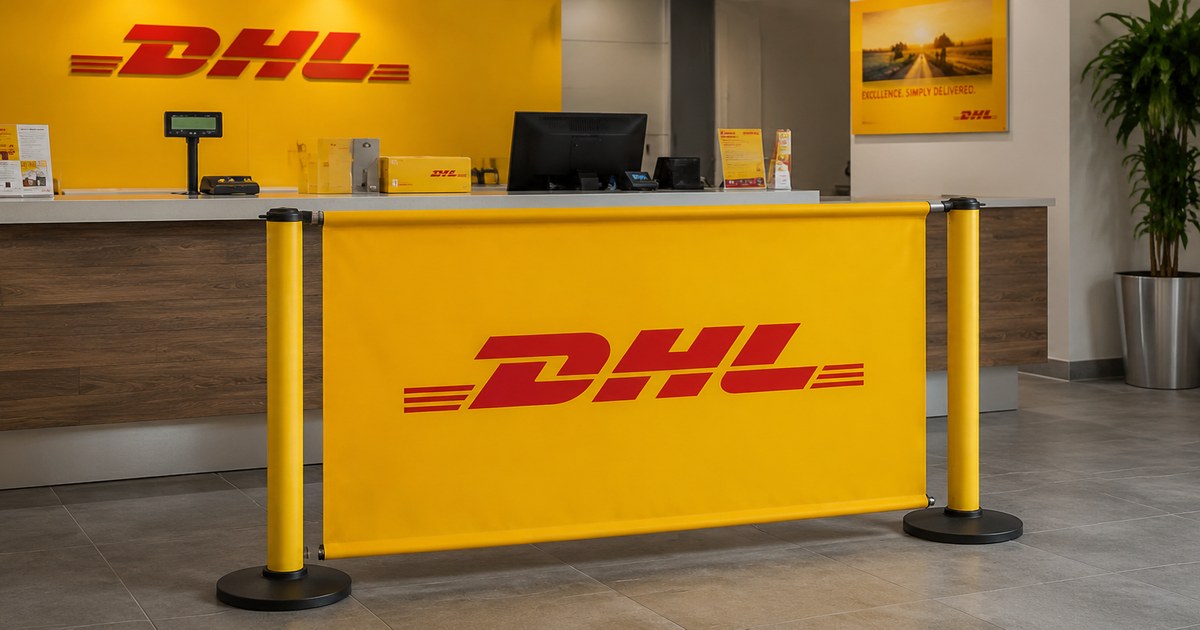 Tips & Advice Custom printed barriers: divide your space and show your brand A free-standing barrier with a banner in your colours: divide and communicate in a single move. Uses, personalisation…
  Our ranges in detail Which base for your barrier post? The 6 bases compared Weighted, magnetic, stackable, fixed or removable: the comparison of the 6 barrier post bases.
 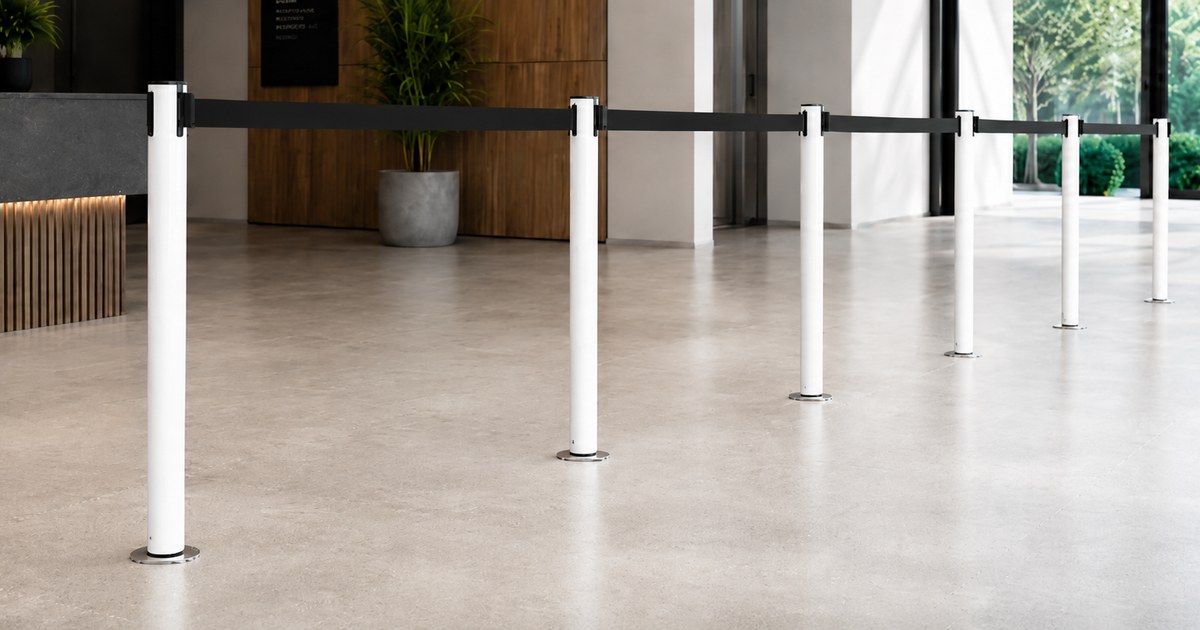 Tips & Advice Removable socketed barrier post: fixed anchoring, mobile freedom A recessed, discreet anchor you remove at will to free the floor: all about the removable socketed barrier post.
 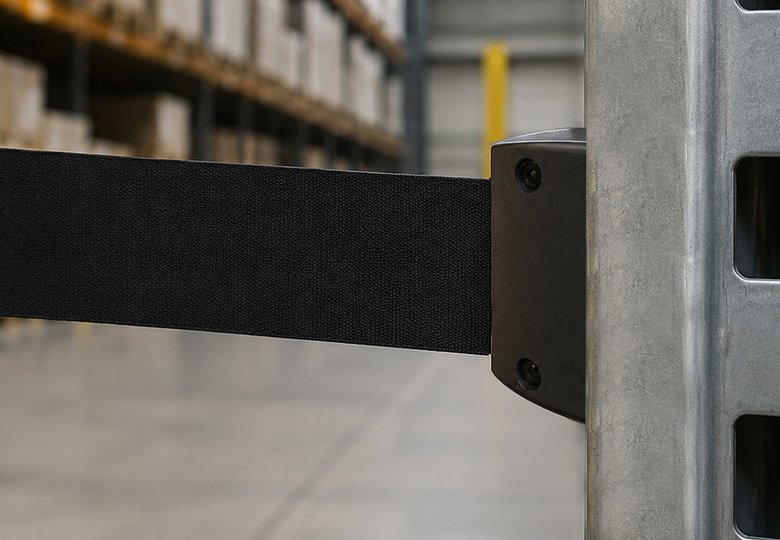 Tips & Advice Strap End: What is the Purpose of Each Finishing Type for Guidance Posts? Standard, security, magnetic or anti-panic: discover the purpose of each strap end for crowd control posts and why…
 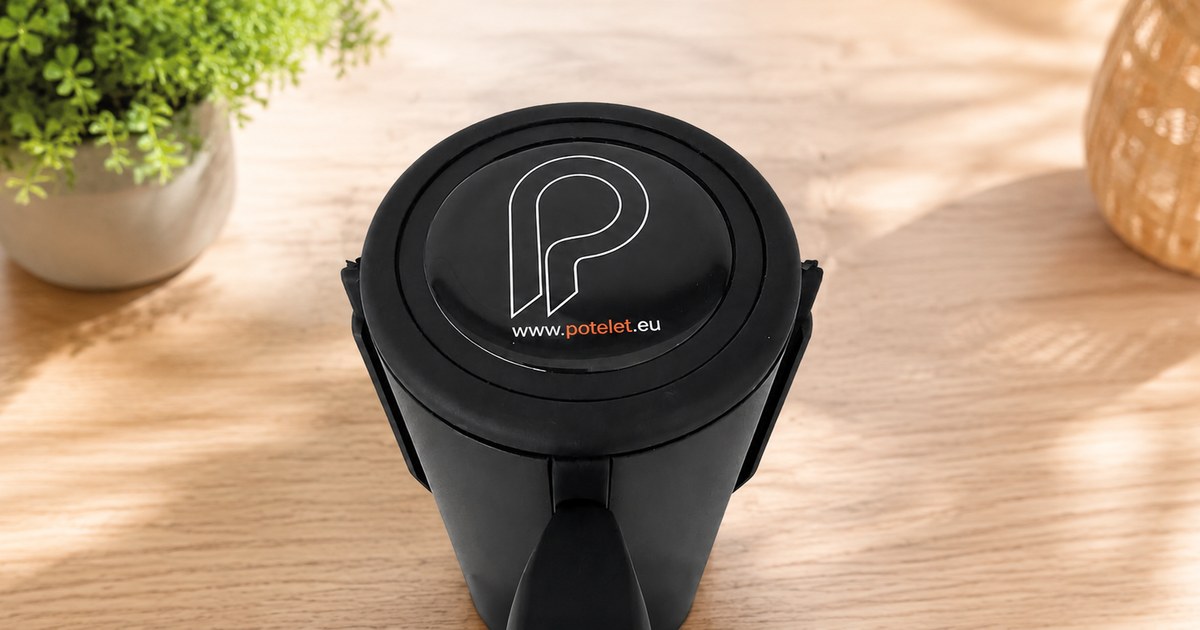 Tips & Advice Post Cap with Strap: Standard, White Label or Customised? Standard, white label or bespoke: the three cap finishes for Potelet® strap posts and how to choose yours.
 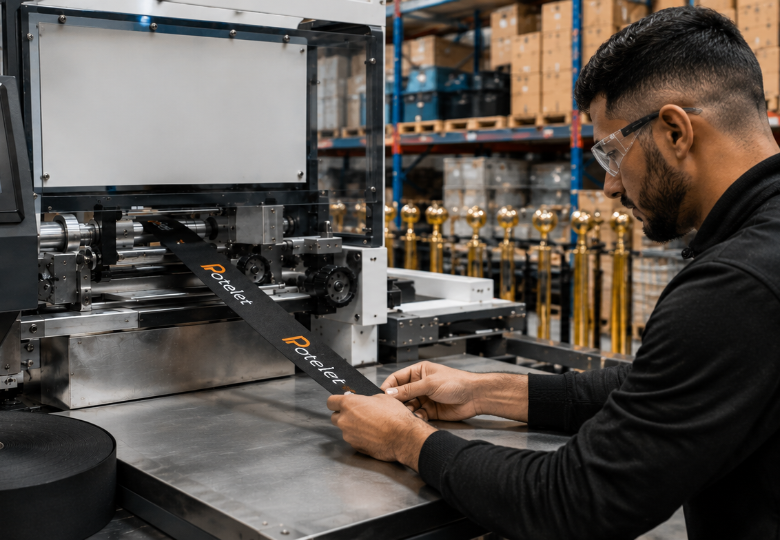 Tips & Advice For personalising the straps on your crowd control posts, insist on textile sublimation! Explanation. Personalise your crowd control post straps with textile sublimation for a professional and durable finish!
  Customisation How to personalise your post strap? Complete configurator guide Discover how to create your personalised strap in 7 steps: RAL colour, HD logo, front/back printing. Our free online configurator for your…