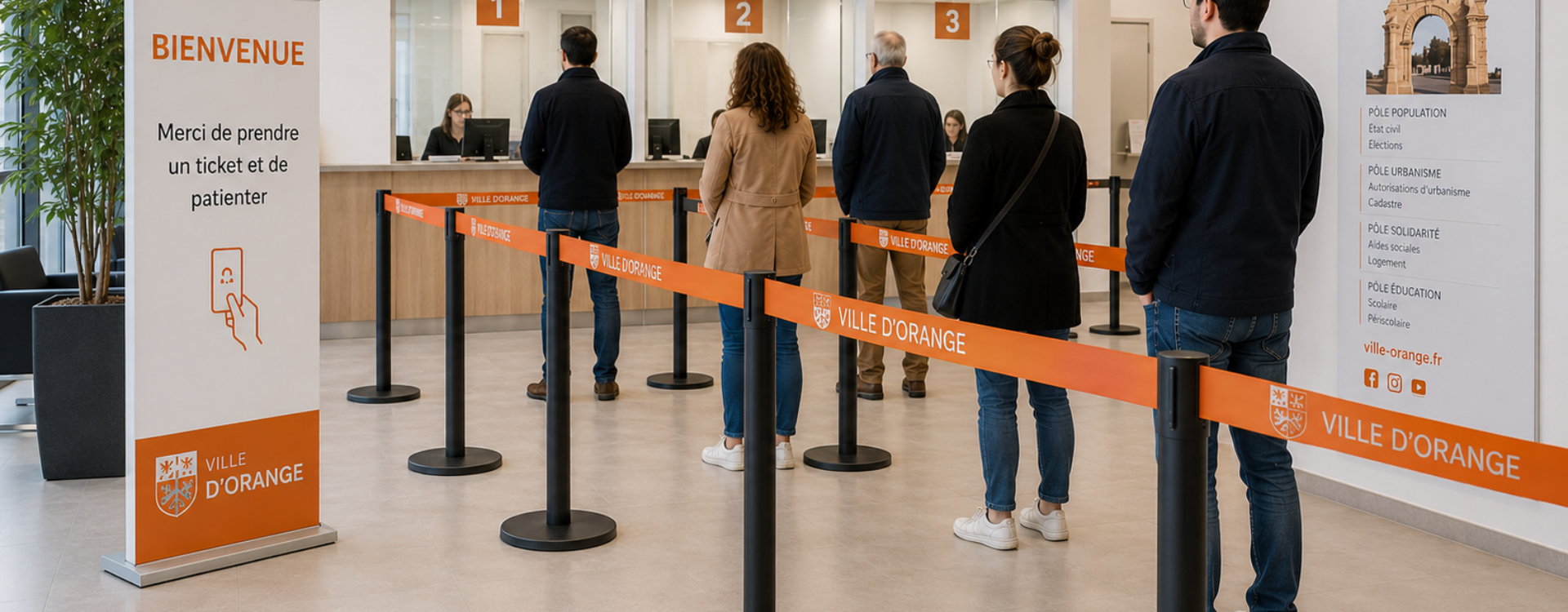
Flow management & public receptionOptimising reception and queuing at town halls and prefectures
In public services, poor queue management generates frustration, disorganisation and damage to the institution's image. Discover how to effectively arrange your reception areas to streamline visitor flows and ensure quality service.
Town halls, prefectures, sub-prefectures, tax offices, family benefit centres… Public administrations welcome dozens, sometimes hundreds of visitors each day. Whether filing a document, renewing an identity document or obtaining information, each user must be directed, received and handled in the best possible conditions. Yet managing queues at town halls or prefectures remains a daily challenge for many site managers. Between peak visitor flows, the diversity of procedures to be processed and regulatory obligations relating to accessibility, the challenge is substantial. This article offers you a comprehensive guide to understanding the specific issues facing administrations and implementing concrete, effective and lasting solutions.
The specific challenges of managing queues in public administration
Managing flows in a public service is not comparable to managing queues in a shop or airport. Administrations face constraints unique to them, which make the issue of organising reception particularly complex.
A heterogeneous public with varied needs
Unlike a specialist shop, a town hall or prefecture receives an extremely varied public: elderly people, families with young children, people with disabilities, users unfamiliar with French, people in administrative distress… Each of these profiles has different needs in terms of guidance, processing time and waiting comfort. The guidance solution must therefore be universal, legible and adaptable.
Peaks in visitor numbers that are difficult to anticipate
Certain periods generate massive visitor flows: back to school, document renewal campaigns, tax declaration periods, or local events. These peaks can quickly disrupt a poorly equipped reception area, creating chaotic queues that spill into corridors or even outside the building.
Strict regulatory obligations
Buildings open to the public (ERP) in categories 1 to 5 are subject to precise regulations regarding accessibility and safety. Signage, demarcation of waiting areas and guidance for people with reduced mobility must comply with strict standards. For more information on this topic, consult our dedicated article on queuing guidance obligations for ERP buildings.
💡 Worth noting: A well-organised queue reduces the perceived waiting time by 20 to 30 % according to several studies on queue psychology. A user who understands the organisation and sees the queue moving is significantly less stressed than a user left to their own devices in a poorly marked space.
Diagnosing the reception area before redesigning
Before choosing equipment or reorganising a space, it is essential to carry out a precise diagnosis of the current situation. This preliminary step makes it possible to identify friction points and define clear action priorities.
Mapping visitor flows
The first step is to observe and map user movements throughout the building. Where do queues form spontaneously? What are the congestion points? Which spaces are underused? This analysis makes it possible to understand visitors' natural behaviour patterns and anticipate problems before they occur.
Identifying procedure types
Not all procedures have the same processing time. In a town hall, registering a vital record is much quicker than processing a planning permission application. It is therefore relevant to distinguish queues according to the nature of requests: fast-track counter for simple queries, dedicated counter for complex cases. This segmentation significantly reduces average waiting times.
Assessing the capacity of the waiting area
How many people can your reception area accommodate simultaneously in dignified and safe conditions? This question is fundamental. It directly determines the number of guidance posts required, the length of straps to be provided and the queue corridor configuration. To help you with this calculation, our guide on how many guidance posts are needed for a queue will provide you with concrete elements.
Essential equipment for structuring a queue in administration
Once the diagnosis is complete, it is time to choose equipment suited to your context. Administrations have specific needs that naturally guide them towards certain solutions.
🔗
Retractable strap posts
The ultimate modular solution, retractable strap posts allow you to create guidance corridors that can be adapted to the configuration of the day. Ideal for spaces with variable geometry.
🪧
Signage panels
Essential for directing users from the moment they enter the building. Universal pictograms, directional arrows, counter identification: clear signage reduces repetitive questions to staff.
🎟️
Ticketing system
For administrations with high traffic, the ticket dispensing machine combined with a call display system allows users to wait seated, reducing fatigue and tension.
🪑
Adapted waiting furniture
Sufficient seating, including spaces for people with reduced mobility, contributes to comfort and dignity of reception. Furniture must be robust, easy to clean and resistant to intensive use.
Why retractable strap posts are particularly suited to administrations
Among all available equipment, retractable strap posts occupy a central place in queue management for administrations. Their modularity is their main advantage: in just a few seconds, a member of staff can completely reconfigure the queue route to adapt to current visitor levels. During an unexpected rush, it is simply a matter of adding posts to extend the queue; during quiet periods, they can be removed to free up space. This flexibility is impossible with fixed barriers or rigid systems.
Furthermore, retractable strap posts have a professional and institutional appearance that corresponds to the image administrations wish to project. Available in several finishes (brushed stainless steel, chrome, powder-coated), they integrate harmoniously into renovated or traditional reception halls. Their maintenance is minimal and their durability, designed for high-traffic environments, makes them a rational investment over the long term.
Accessibility and inclusion: non-negotiable imperatives
Public buildings are subject to particularly strict accessibility requirements. The Equality Act 2010 requires that all ERP buildings be accessible to people with disabilities, regardless of the nature of that disability: mobility, visual, hearing or cognitive.
Adapting the queue for people with reduced mobility
The minimum width of queue corridors must allow the passage of a wheelchair, a minimum of 90 cm of free passage. Posts must be positioned so as not to create unexpected obstacles. It is also recommended to provide priority access or an alternative route for people with reduced mobility, to avoid them having to traverse the entire queue.
Inclusive signage and multilingualism
Particularly at prefectures, users may not be fluent in English. Using universal pictograms on signage, complemented by translations in the most widely spoken local languages, facilitates orientation for everyone. For visually impaired people, strong colour contrasts and tactile paving strips on the floor complete the system.
Considering the psychological dimension of waiting
Waiting is experienced differently depending on whether the user understands what is happening or not. Providing information on estimated waiting time, clearly indicating the number of open counters, offering information materials to consult while waiting (leaflets, dynamic display screens): all these are levers that transform an imposed wait into an accepted one.
📋 Accessibility checklist: Corridor width ≥ 90 cm · Pictogram signage · Tactile paving strips on floor · Accessible seating available · Counter at adapted height · Hearing loop for hearing-impaired · Sufficient lighting without glare.
Operational organisation: training staff and maintaining equipment
The best equipment in the world is useless without appropriate human organisation. Physical queue layout must be accompanied by reflection on reception staff practices and equipment maintenance.
Defining clear protocols for staff
Who is responsible for setting up the queue in the morning? When should you switch from a "low visitor flow" configuration to a "peak" configuration? How should you handle a visitor who cuts in line or becomes impatient? These questions should be addressed in written procedures and regular training. A member of staff well-trained in flow management can defuse the vast majority of tensions before they escalate.
Adapting configuration in real time
One of the great advantages of retractable strap posts is precisely their ease of manipulation. A member of staff can, in less than two minutes, completely reconfigure the queue to adapt to an unforeseen situation: arrival of a group, closure of a counter, technical incident. This responsiveness is impossible with fixed systems or heavy barriers to move.
Equipment maintenance and regular inspection
A post with a faulty retractable strap, illegible signage or a broken chair immediately degrades the institution's image and may present safety risks to users. It is recommended to incorporate the inspection of reception equipment into the building's maintenance routines, with weekly visual checks and monthly in-depth inspections.
Configuration examples according to type of administration
Each type of administration has its own specificities. Here are some typical configuration examples that can serve as a basis for reflection.
The medium-sized town hall (5,000 to 50,000 inhabitants)
In a medium-sized town hall, reception typically centralises several types of procedures. The recommended configuration includes a main waiting area with a single queue feeding multiple counters (serpentine principle), complemented by a seated waiting area for users with appointments. Clear entrance signage indicates the different services available and their location in the building.
- 6 to 10 retractable strap posts for the main queue corridor
- 2 to 3 directional signage panels
- Seated waiting area with 10 to 20 seats
- Dedicated accessible space with priority access
The prefecture or sub-prefecture
Prefectures process significant volumes of applications related to residence permits, driving licences and identity cards. The organisation is usually more complex, with several distinct queues depending on the type of procedure. The ticketing system is particularly suited to this context, allowing users to wait seated and be called by number. Posts then structure waiting areas around ticket dispensing machines and access to counters.
- Multiple distinct queue areas by procedure type
- Numbered ticketing system with dynamic display
- 15 to 30 posts depending on hall size
- Multilingual signage mandatory
- Seated waiting room with substantial capacity
The identity document issuance centre
These specialist facilities, often very busy, require particularly rigorous organisation. The outdoor queue (for peak traffic days) must be planned and marked out, with weather protection if possible. Inside, the flow is usually linear: reception → file verification → handling by staff → document handover. Each stage must be clearly marked out in the space.
Conclusion: investing in reception means investing in citizen trust
Organising queues at town halls or prefectures is not a secondary or purely logistical matter. It is a direct reflection of the consideration the institution shows to its users. A well-designed reception, with appropriate equipment, clear signage and trained staff, transforms an often-dreaded experience into a smooth and serene process.
The benefits are multiple and measurable: reduction in tensions at reception, improved user satisfaction, time savings for staff who can focus on their core work rather than managing conflicts related to waiting, and strengthened institutional image. In a context where the relationship between citizens and their administrations is sometimes tense, each improvement in the reception experience contributes to restoring trust.
Investment in quality equipment - robust posts, professional signage, adapted furniture - is quickly recovered through the reduction of incidents, improved counter throughput and improved well-being of reception staff. It is a strategic choice that many local authorities have already made, with tangible results within the first few weeks of implementation.
Equip your reception hall with professional posts suited to administrations
Discover our complete range of retractable strap posts, designed to effectively structure queues in town halls, prefectures and all buildings open to the public.
View our retractable strap posts



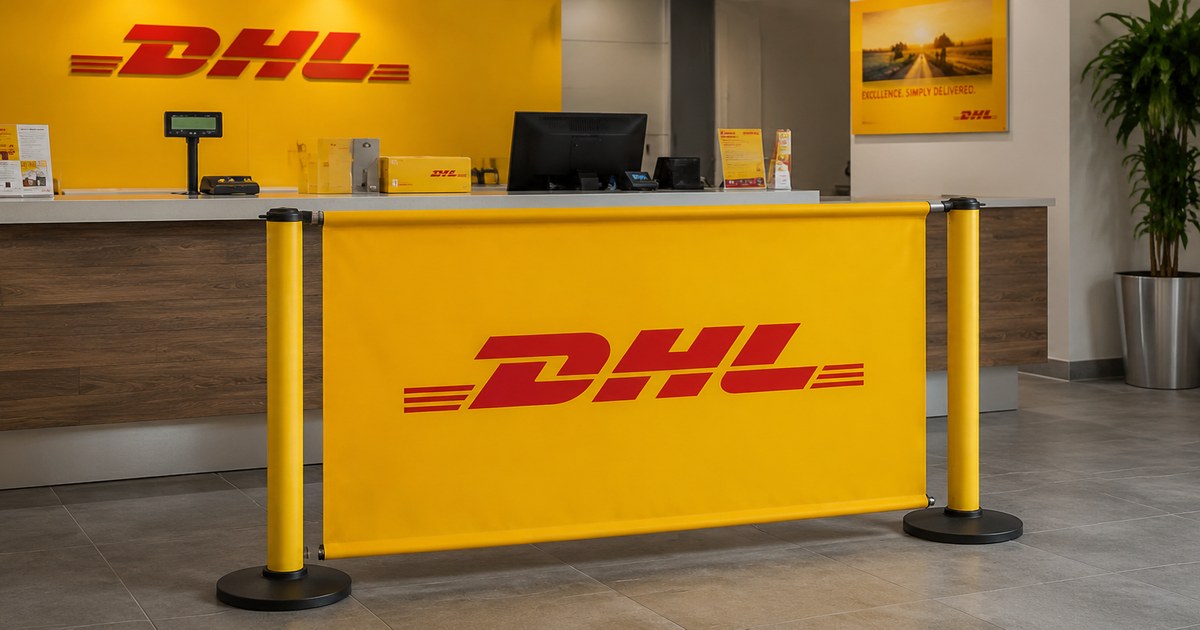 Tips & Advice Custom printed barriers: divide your space and show your brand A free-standing barrier with a banner in your colours: divide and communicate in a single move. Uses, personalisation…
 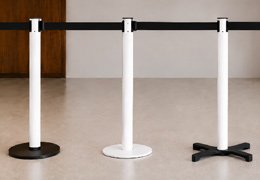 Our ranges in detail Which base for your barrier post? The 6 bases compared Weighted, magnetic, stackable, fixed or removable: the comparison of the 6 barrier post bases.
 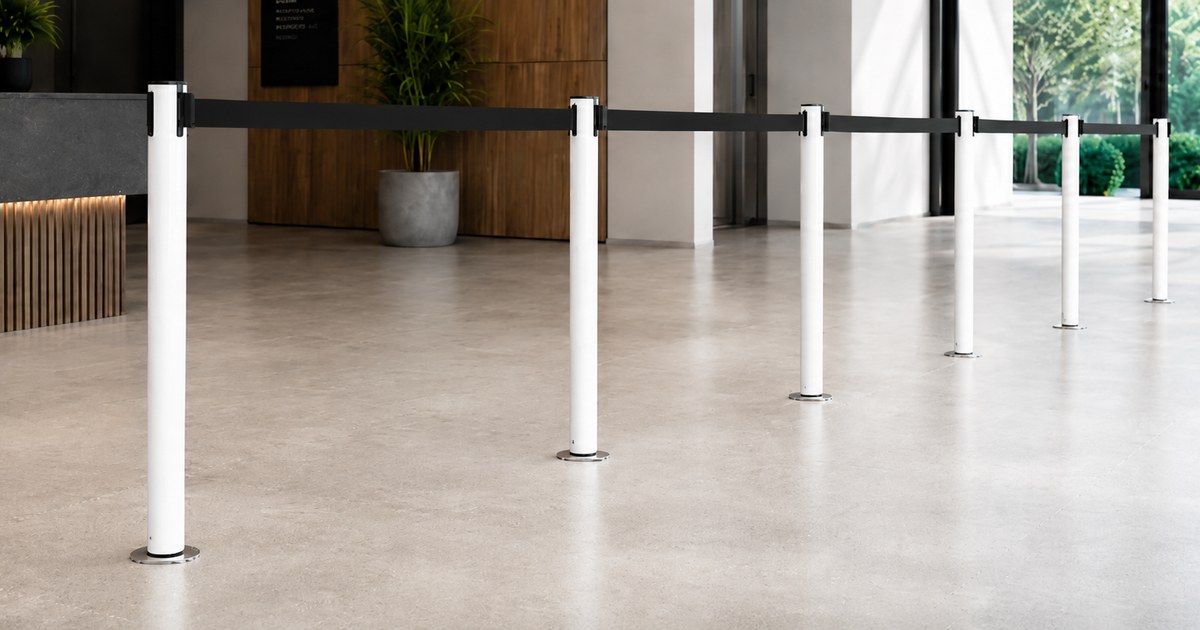 Tips & Advice Removable socketed barrier post: fixed anchoring, mobile freedom A recessed, discreet anchor you remove at will to free the floor: all about the removable socketed barrier post.
 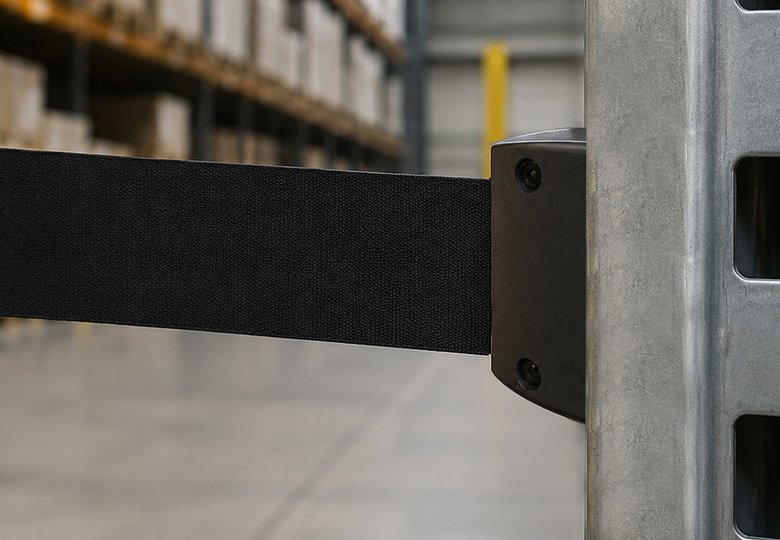 Tips & Advice Strap End: What is the Purpose of Each Finishing Type for Guidance Posts? Standard, security, magnetic or anti-panic: discover the purpose of each strap end for crowd control posts and why…
 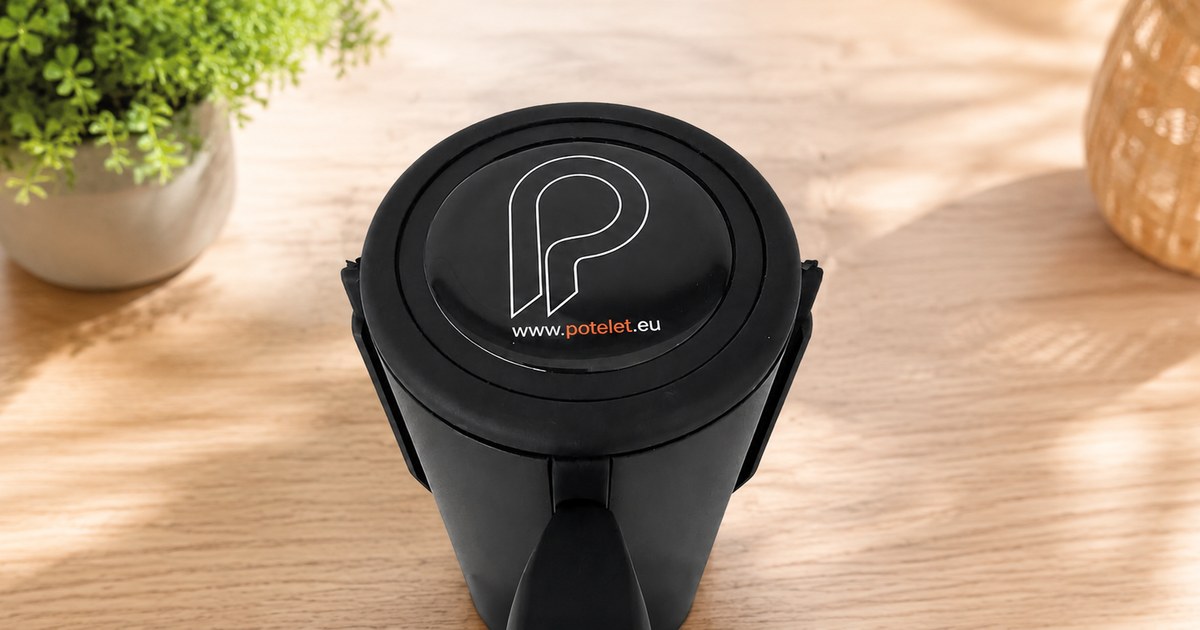 Tips & Advice Post Cap with Strap: Standard, White Label or Customised? Standard, white label or bespoke: the three cap finishes for Potelet® strap posts and how to choose yours.
 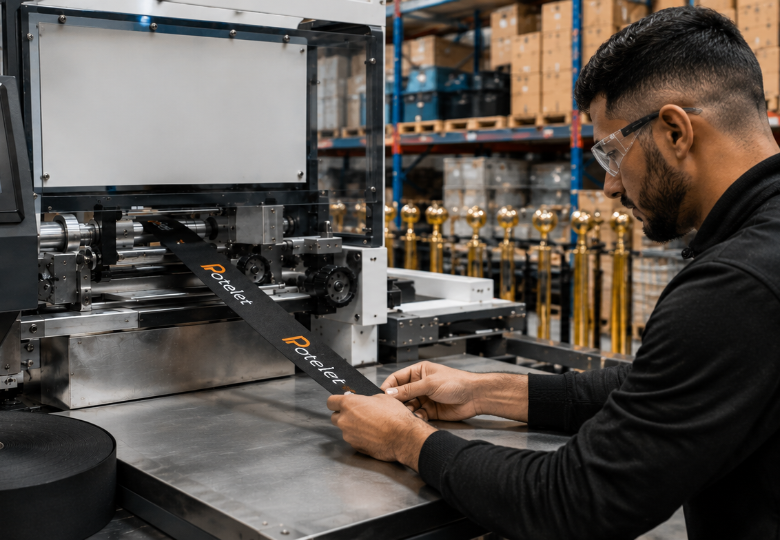 Tips & Advice For personalising the straps on your crowd control posts, insist on textile sublimation! Explanation. Personalise your crowd control post straps with textile sublimation for a professional and durable finish!
  Customisation How to personalise your post strap? Complete configurator guide Discover how to create your personalised strap in 7 steps: RAL colour, HD logo, front/back printing. Our free online configurator for your…