Buying guideHow to choose a barrier rope for a hotel or a building open to the public?
Velvet, braided rope or semi-elastic cord: the right choice depends on the area to be fitted out, the post already in place and the width of passage to keep clear.
The rope is often chosen last, by colour, once the posts have been ordered. That is where the two most common unpleasant surprises come from: a rope that does not hook onto the post you received, and a handsome line of velvet that encroaches on a passage the venue was supposed to keep clear. In a hotel, as in any building open to the public, it is better to work the other way round: the area first, then the passage, then the post and rope pairing. This guide helps you do that, using the products in our Ropes, Cables and Chains category as concrete reference points.
The five families of rope to know
A rope is defined by its material, its length, its diameter and, above all, by what it hooks onto. Here is what our product sheets state.
| Rope | Length | Diameter | Hooks onto | Style |
|---|
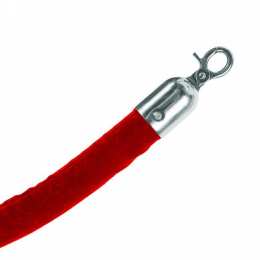
| Velvet rope | 150 cm | 38 mm | VIP Range posts | Prestige, entrance, red carpet |
| Twisted rope | 150 cm | 4 cm | VIP Range posts | Classic, strong presence |
| DESIGN hook rope | 2 m | 3 cm | DESIGN Range posts | Versatile, everyday use |
| POST rope | 2 m | 24 mm | POST Range posts only | Economical, service areas |
| Semi-elastic cord | By the metre | 6 mm | LINE Range posts | Discreet, keeps people at a distance |
Velvet: for venues you want to stage
This is the rope for the entrance to an evening event and the prestige lobby. The red velvet rope with chrome hooks remains the reference, its version with gold hooks goes with gold posts, and the blue velvet rope offers a more sober style, close to a corporate identity. Velvet hangs in a gentle curve between two posts: it suggests a boundary more than it enforces one. To find out more about the finishes, read our article on the velvet rope barrier post.
Braided or twisted rope: made to last without dominating
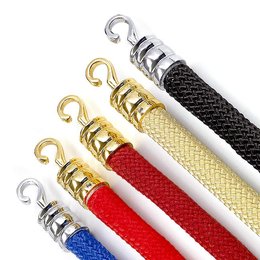
The DESIGN rope, made of multi-strand braided polypropylene, comes in bright red, black, cream, burgundy and white, with chrome or gold hook ends. It is the simplest choice for a reception or restaurant where the set-up is handled every day. The black twisted rope, which is thicker, gives a traditional ropework look and marks out the space more strongly.
The POST rope: for service areas
With its hard plastic hooks, this 2 m rope pairs with the POST Range barrier posts, the most economical in the catalogue. It suits a luggage room, a delivery entrance or a floor under refurbishment: places where budget matters more than effect.
The semi-elastic cord: to protect without framing
Slender and available in seven colours, it is cut with scissors to the length of each span and clips onto the LINE Range rope posts. It is the right tool for a hotel that displays artworks or collectors' furniture. How to fix it is explained in this dedicated guide.
In a hotel, each area has its own rope
A hotel does not need a single solution, but two styles at most, consistent with the décor. For an overview of the sector, also see our page on hospitality and catering.
| Area | What you expect from the rope | Suggested choice |
|---|
| Reception, concierge desk | Organise the wait without spoiling the welcome | Cream or burgundy rope on a brushed stainless steel rope barrier post, or black rope on a matte black rope barrier post |
| Bar or restaurant entrance | Mark the access, open and close quickly | Velvet on a chrome Prestige barrier post or DESIGN rope on a champagne rope barrier post |
| Breakfast, buffet | Channel people during service, then disappear | DESIGN rope, easy to unhook and store |
| Function room | Stage an occasional welcome | Velvet and VIP posts: see our gala queue guide |
| Spa, upper floor, private access | Signal a closed access | A single rope hung from the wall, with a chrome wall bracket or a gold wall hook |
| Luggage room, service access | Mark off at the lowest cost | POST rope and, on the wall side, a POST wall receiver |
| Artworks, collectors' items | Keep people back while staying discreet | Semi-elastic cord on a LINE post |
If your project goes beyond the choice of rope and affects the whole organisation of the spaces, our article on guiding visitors in hotels and at events broadens the subject.
Colour tip: the rope is seen from afar, the post up close. Start from the dominant colour of the floor or carpet, then choose a rope that stands out clearly from it: it will look more elegant and be easier for everyone to spot.
In a public building (ERP in France), the real issue is the width left clear
In the French classification, a hotel is a public building of type O, a restaurant is type N, and a meeting or performance hall is type L. The rope itself is not mandatory equipment there: none of the texts we have read requires one to be installed. However, once it is in place it takes up space, and that is where the rules apply. The pointers below concern France.
Accessibility: 1.40 m or 1.20 m of clear passage
| Building | Minimum width of the accessible route | Occasional narrowing, over a short length |
|---|
| New public building (French arrêté du 20 avril 2017) | 1.40 m clear of any obstacle | Between 1.20 m and 1.40 m |
| Existing public building (French arrêté du 8 décembre 2014) | 1.20 m clear of any obstacle | Between 0.90 m and 1.20 m |
These widths also apply to horizontal circulation routes inside the building. Measure them from the edge of the base, not from the line of the rope: a base 35 cm in diameter projects about 17 cm on each side of the post axis. To keep a clear 1.40 m between two rows of posts, you therefore need about 1.75 m from centre to centre, and about 1.55 m to keep 1.20 m.
Also think of blind and partially sighted people. A cane detects the base, but passes under a rope stretched at mid-height. The French texts require that furniture, bollards and posts on the route meet a detection profile, for example 1.10 m high and 6 cm in diameter. Our standard-size rope posts measure 90 to 99 cm: they are not designed for that profile. Good practice is therefore to set up the queue beside the accessible route, not on it. Where you are concerned about people passing under the rope, a double rope post adds a second, more visible line, without that amounting to regulatory approval.
Fire safety: nothing movable in an escape route
This is the point most often overlooked. Under article CO 37 of the French safety regulations, no projection or storage may reduce the regulatory width of escape routes. Where an escape route is wider than the required minimum, furniture may occupy the surplus, provided it does not hinder the rapid movement of the public or the operation of self-closing doors, and cannot be moved or knocked over. Only widenings forming a waiting or rest area are exempt from this last condition. Protected staircases, for their part, must be kept free of any fittings.
A movable post and its rope can by nature be moved and knocked over. In practice: no queue and no line of posts in an escape route or in front of an exit, even if there is room left, except in a widening designed for waiting and after the agreement of your safety officer. If lasting marking is needed nearby, look instead at the floor-mounted rope posts, and have their position approved. As for the argument “we will remove them in an emergency”, it does not replace these rules: the width must be clear before the evacuation, not during it.
How these widths are calculated: the regulations work in units of passage of 0.60 m, raised to 0.90 m for one unit and to 1.40 m for two. The required width depends on the number of people admitted: it is set out in your venue's safety file, which takes precedence over any general guideline.
Reaction to fire: ask for the supporting document
If your safety file or your safety commission requires a reaction-to-fire classification for the textiles in the venue, do not assume it for any rope, velvet included. Ask the question before ordering, through our quote request, and install the product only with the document that matches your requirement.
In Belgium: different texts, the same reflex
The category of public building used in this guide is a French one. In Belgium, accessibility is governed by regional rules and fire prevention goes through your emergency zone (zone de secours). The figures above do not carry over as they stand: ask for the applicable values before drawing the queue.
Limits of this guide: it summarises French texts to help you ask the right questions. It is not a compliance opinion: for your venue, it is your safety officer, your inspection body or the competent commission that decides.
Check compatibility before ordering
Ropes are not universal. Each family was designed for the head of a specific range, and our product sheets say so: the POST rope is reserved for POST posts, the DESIGN rope for DESIGN posts, velvet and twisted rope for VIP posts, and the semi-elastic cord for LINE posts.
- You are starting from scratch: choose the rope, then the post from the same range. Most of our rope posts are sold without a rope: order both.
- You already have Potelet posts: start again from the range shown on your invoice and see the list of Rope Barriers.
- You have posts from another brand: the braided queue barrier rope sold by the metre, 30 mm in diameter and supplied without hooks, lets you reuse your existing fittings. First check that they suit this diameter.
- One side runs along a wall: replace the last post with a wall fixing from the same range. You save a base on the floor, and therefore width.
How many ropes and posts should you plan for?
The calculation starts from the length to be marked out. One span corresponds to one rope, and a straight line always has one more post than ropes. Space the posts slightly less than the length of the rope to keep an even curve, then adjust on site: around 1.30 to 1.40 m with a 150 cm rope, around 1.80 m with a 2 m rope. LINE posts accept, according to the product sheet, from 1.5 to 2.5 m.
Example: for a 6 m line in front of a reception desk with 2 m DESIGN ropes, spaced about 1.80 m apart: 6 divided by 1.80 gives 3.3, so 4 spans, rounded up. You need 4 ropes and 5 posts. Add a spare rope, especially in velvet.
If stability worries you on a particular floor, our comparison of bases will help you choose the right base. And if the posts are put out and put away often, the storage trolley carries up to 16 posts with round bases, with a central space for hanging the ropes without creasing them.
Frequently asked questions
Rope, cord, velvet rope: are they the same thing?
In everyday language, yes. “Rope” usually means the finished item with its fittings, “cord” puts the emphasis on the material, and “velvet rope” is the velvet version. What matters when buying remains the length, the diameter and the compatible range of posts.
Which rope should you choose for an upmarket hotel?
The number of stars dictates nothing. For a staged entrance, velvet works very well. For a reception desk used all day, a cream, burgundy or black braided rope on a post matching the décor will be more discreet and easier to handle.
Is a rope enough to forbid access?
It signals a boundary, but physically stops no one from walking through. For a genuinely prohibited or dangerous area, you need a suitable closure and clear signage.
Can a rope be placed in front of an emergency exit?
No. Exits and escape routes must remain clear across their full regulatory width, and a movable system must not be installed there. Move the queue or rethink its layout.
Can these ropes be used outdoors?
The product sheets for the velvet rope, the twisted rope, the DESIGN rope and the POST rope recommend indoor use. For a terrace or an exposed entrance, ask us before ordering.
Should you prefer a belt barrier post in a public building?
For long queues and heavy flows, the retractable belt is often more practical, because it closes by itself. The rope keeps the advantage in places where appearance comes first. Both obey the same width rules. The LIMIT Range posts also let you print your branding on the belt.
In brief
To choose a rope well, proceed in this order: define the area and its style, check the width to be left clear and that the spot is not an escape route, then take the rope and the post from the same range. In a hotel, two families are usually enough. In any public building, the rule fits in one sentence: the rope adapts to the passage, never the other way round.
Find the rope that suits your posts
Velvet, braided rope, semi-elastic cord: compare lengths, colours and compatibility.
See ropes and cords



 Tips & Advice Setting up a queue for a gala or VIP event: a complete guide How can you welcome your guests without forming a visible queue? Flow calculation, a five-sequence route, VIP and press…
 Tips & Advice How to choose a barrier rope for a hotel or a building open to the public? Which rope for a hotel reception, a restaurant or a public building? The five families compared, the choice area by…
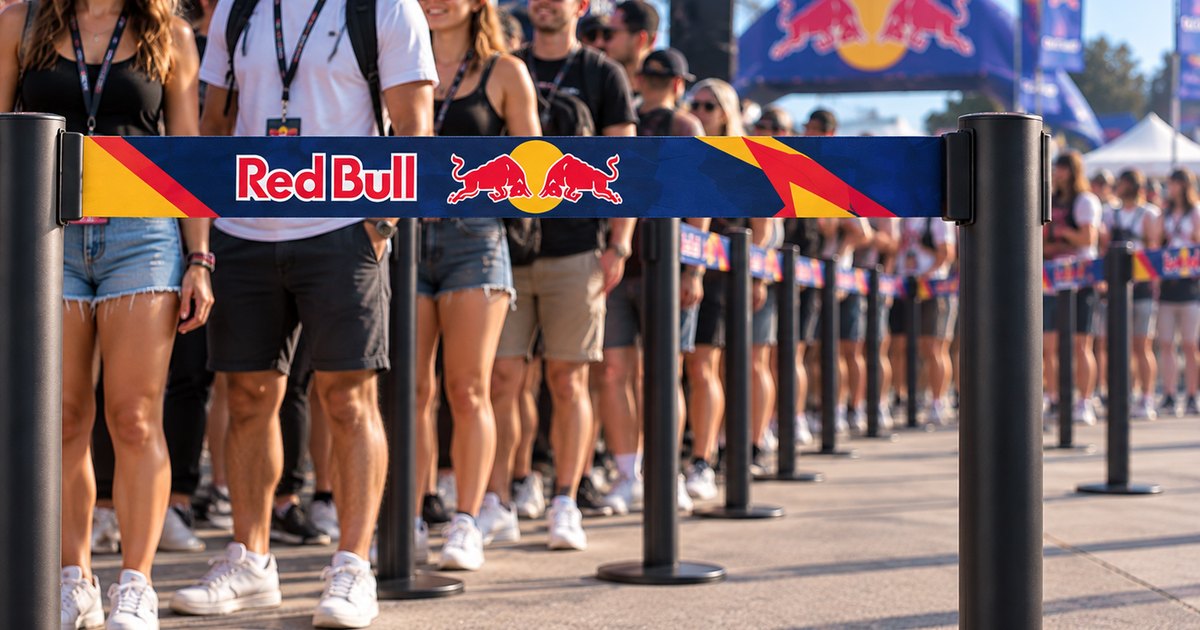 Tips & Advice Queue Sponsorship: Get Your Partners to Fund Your Barrier Posts Stadiums, trade shows, museums, airports, shopping centres: the belt on your barrier posts is advertising space that…
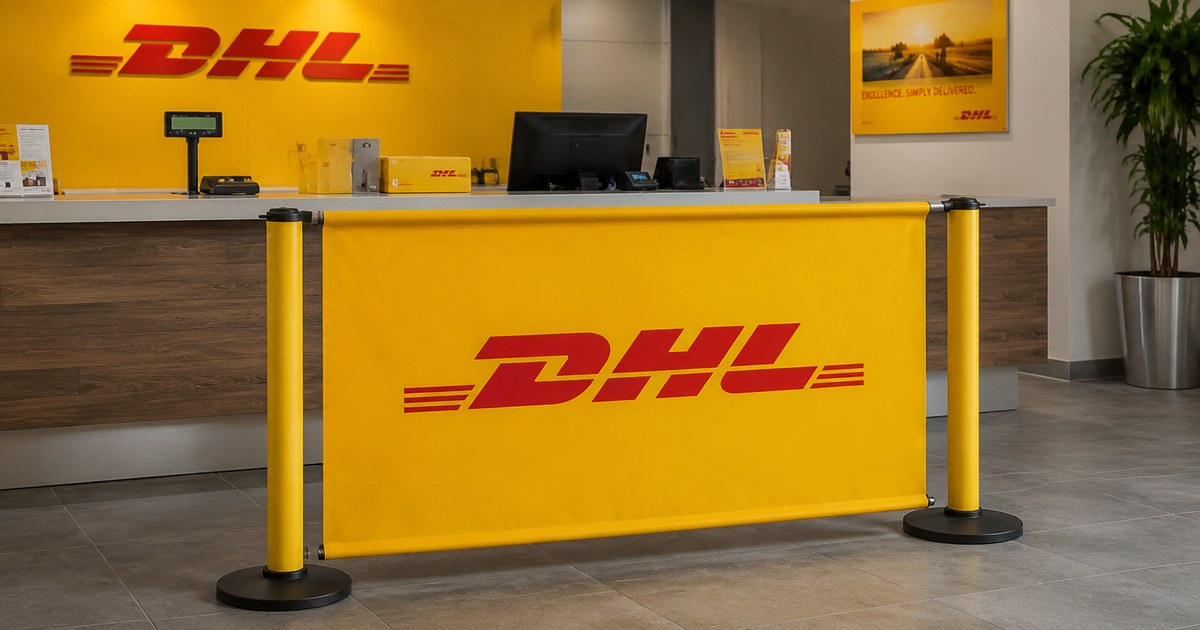 Tips & Advice Custom printed barriers: divide your space and show your brand A free-standing barrier with a banner in your colours: divide and communicate in a single move. Uses, personalisation…
 Our ranges in detail Which base for your barrier post? The 6 bases compared Weighted, magnetic, stackable, fixed or removable: the comparison of the 6 barrier post bases.
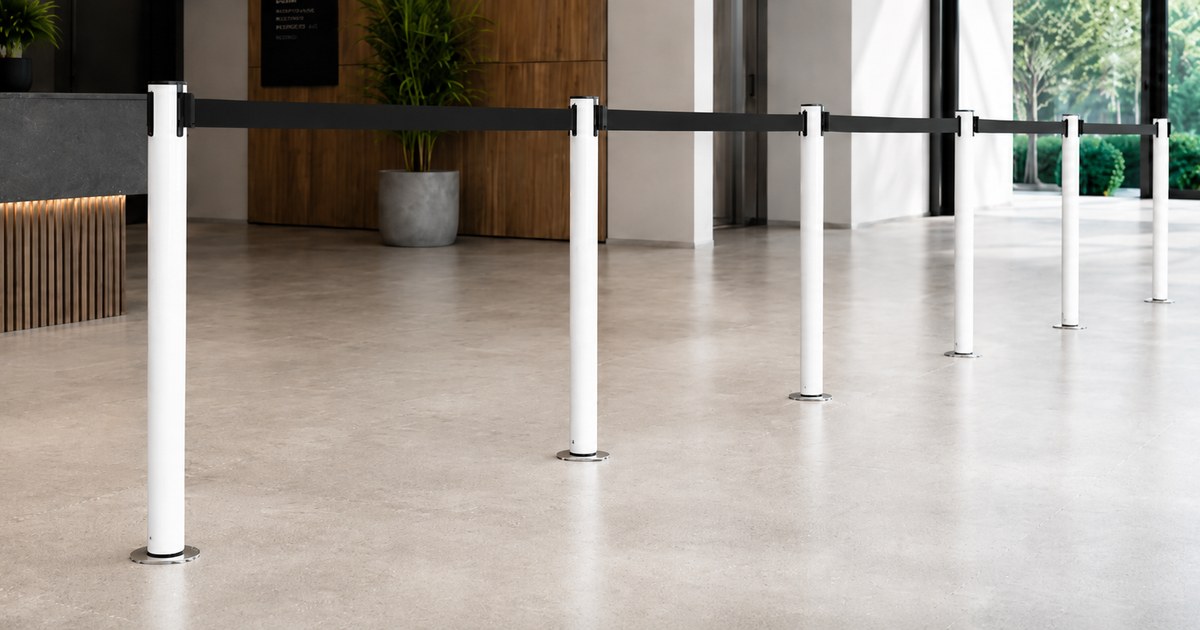 Tips & Advice Removable socketed barrier post: fixed anchoring, mobile freedom A recessed, discreet anchor you remove at will to free the floor: all about the removable socketed barrier post.
 Tips & Advice Strap End: What is the Purpose of Each Finishing Type for Guidance Posts? Standard, security, magnetic or anti-panic: discover the purpose of each strap end for crowd control posts and why firefighters require…
 Tips & Advice Post Cap with Strap: Standard, White Label or Customised? Standard, white label or bespoke: the three cap finishes for Potelet® strap posts and how to choose yours.
 Tips & Advice For personalising the straps on your crowd control posts, insist on textile sublimation! Explanation. Personalise your crowd control post straps with textile sublimation for a professional and durable finish!
 Customisation How to personalise your post strap? Complete configurator guide Discover how to create your personalised strap in 7 steps: RAL colour, HD logo, front/back printing. Our free online configurator for your…