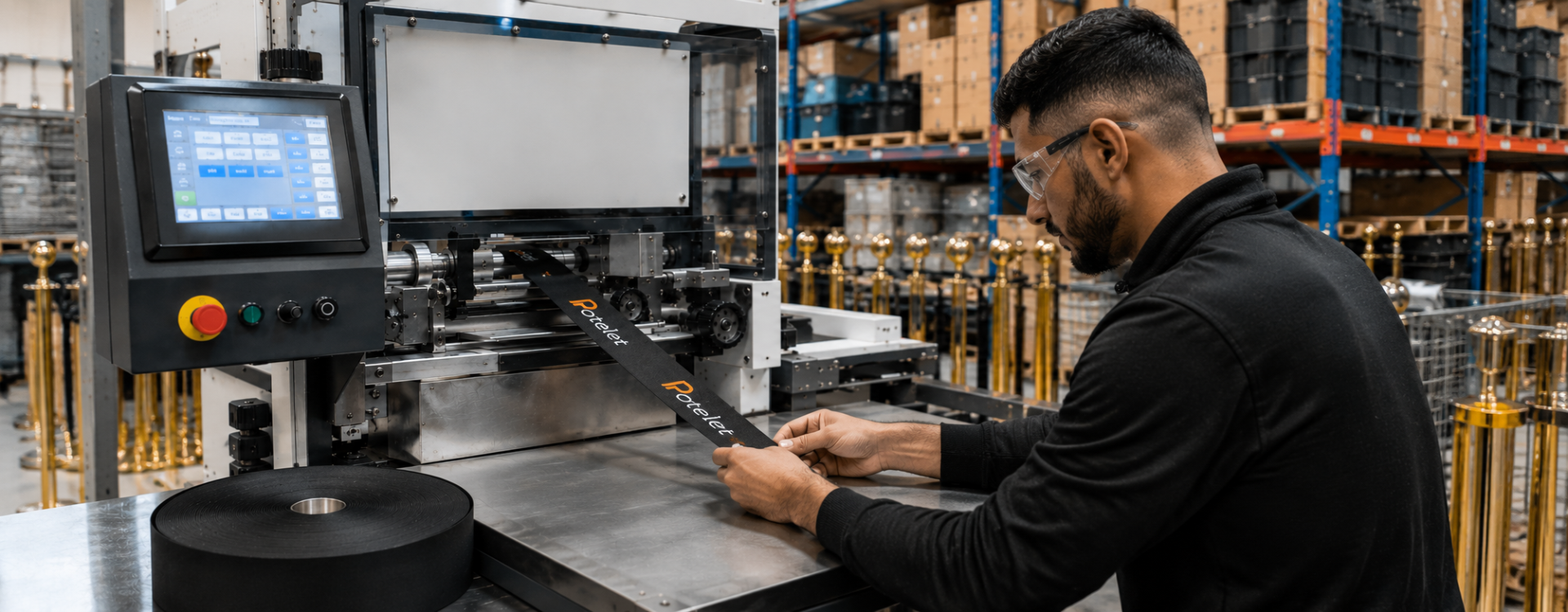
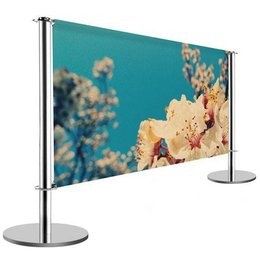
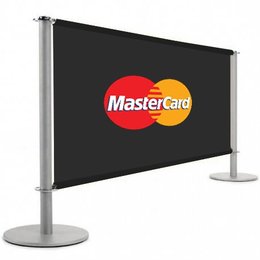
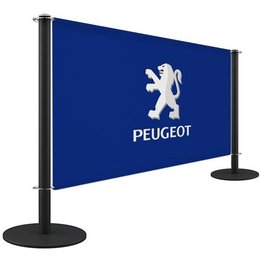
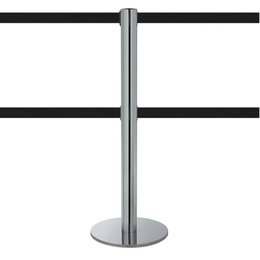
Personalisation & SignageFor the personalisation of your crowd control post straps, demand textile sublimation! Explanation.
The strap on your crowd control post is a communication vector in its own right. Discover why textile sublimation has become the only technique truly up to your standards of quality and durability.
In environments where public reception is carefully managed - hotels, airports, banks, museums, event venues or large retail spaces - every detail matters. Crowd control posts serve not only to channel foot traffic: they actively participate in the brand image of an establishment. The strap, the central and most visible element of the system, is therefore much more than a simple functional accessory. It is a communication medium that deserves particular attention, especially regarding the printing method chosen to personalise it.
Two main techniques compete in the strap personalisation market: screen printing, a historical and widely established method, and textile sublimation, a more recent process but technically superior in almost all professional use cases. This article explains in detail why, if you want a personalised strap that lasts, that shines and that faithfully represents your visual identity, textile sublimation is the essential choice.
Understanding the two techniques: screen printing vs textile sublimation
Screen printing: a proven but limited technique
Screen printing is a stencil-based printing technique that involves passing ink through a stretched screen (the "screen") onto the surface to be printed. Each colour requires a separate screen, which involves significant mechanical preparation. This method is perfectly suited to printing on paper, cardboard, rigid plastic or certain thick textiles. It offers good colour opacity and is well suited to large runs with simple patterns.
However, applied to crowd control post straps - flexible fabric ribbons subjected to repeated mechanical stress (rolling, unrolling, tension) and variable exposure conditions - screen printing quickly shows its limitations. The ink is deposited as a layer on the fabric surface without penetrating the fibres. It therefore remains on the surface, which makes it vulnerable to abrasion, repeated folding and washing.
Textile sublimation: chemistry at the service of durability
Textile sublimation is based on a fundamentally different physico-chemical principle. Special inks based on sublimable dyes are first printed onto transfer paper, then subjected to intense heat (typically between 180 and 210 °C) combined with pressure. Under the effect of heat, the dyes pass directly from the solid state to the gaseous state (this is the sublimation phenomenon) and incorporate themselves into the synthetic fibres of the textile - primarily polyester.
The result is radically different from screen printing: the ink does not form a layer on the fabric, it becomes an integral part of the fabric. The fibres themselves are coloured in depth. This gives the print exceptional properties that we shall detail.
✓ Key point: In sublimation, the ink is not resting on the textile surface - it is part of it. This fundamental difference explains the superiority of the technique across all long-term performance criteria.
The 5 decisive advantages of sublimation for your personalised straps
🎨
Exceptional colour rendering
Millions of shades, perfect gradients, photographs reproduced with absolute fidelity. No chromatic limitations.
🛡️
Maximum durability
Resistance to abrasion, repeated folding and UV without cracking or delamination of the print.
✋
Natural fabric feel
No relief, no added thickness. The strap remains flexible and pleasant, without the feel of a plastic film.
⚙️
Mechanical compatibility
Perfectly adapted to the retract mechanisms of posts, with no risk of jamming or premature wear.
📐
Full-width printing
The design can cover the entire surface of the strap, edge to edge, without restriction on printable area.
Durability and resistance: why sublimation wins in the long term
In a professional use context, crowd control post straps undergo considerable and repeated mechanical stress. Every day, they are stretched, rolled, unrolled, sometimes pulled sharply by impatient visitors. In outdoor or semi-outdoor environments, they are also exposed to UV rays, humidity and temperature variations.
The weak point of screen printing: ink on the surface
With screen printing, the ink forms a film on the surface of the textile. This film, however chemically resistant, cannot indefinitely follow the movements of the textile without cracking. The fold zones - particularly stressed during rolling around the post's internal mechanism - are the first to show signs of wear: micro-cracks, partial delamination, edge bleaching. Within a few months of intensive use, a screen-printed strap loses its neat appearance and betrays its age.
Exposure to UV further accelerates this phenomenon: screen printing inks, even protected by varnishes, yellow or fade over time, impairing the legibility of the message and the visual coherence of the signage.
Sublimation: intrinsic resistance
Because sublimation dyes are integrated into polyester fibres, there is no film capable of delaminating. The strap can be folded, rolled and unrolled thousands of times without the print being altered. Colours remain vivid, edges sharp, text legible. UV resistance is also significantly superior: sublimated dyes are not directly exposed to radiation because they are located inside the fibres, protected by the very structure of the textile.
For equipment managers who want to maintain a fleet of crowd control posts in perfect visual condition over several years, sublimation therefore represents a rational investment, reducing the frequency of strap replacement and associated maintenance costs.
✓ Note: Strap retractors are particularly mechanically stressed due to their length. For these models, sublimation is all the more recommended to guarantee intact printing along the entire length of the strap, including in areas of maximum tension.
Colour fidelity and creative freedom: a major asset for visual identity
For a brand, a hotel chain, an institution or a retail business, visual identity consistency is non-negotiable. Brand guidelines define precise colours - often specific Pantone codes or CMYK/RGB values - which must be respected on all communication media, including crowd control post straps.
Screen printing: significant chromatic constraints
Screen printing works with separated colours: each shade corresponds to a separate screen. Reproducing a gradient, transparency effect or photograph in screen printing is technically complex, costly and rarely satisfactory on flexible fabric. The colours obtained can slightly deviate from target values, particularly because the textile support absorbs ink differently depending on its texture and base colour. For logos containing many colours or complex graphic elements, screen printing quickly reaches its limits.
Sublimation: unlimited palette and photographic accuracy
Textile sublimation works in digital four-colour, which means it can theoretically reproduce any colour, any gradient, any photograph with remarkable accuracy. A logo featuring fine gradients, drop shadows or textured effects will be reproduced faithfully, without compromise. The colours obtained are vivid, luminous and consistent from one strap to another, guaranteeing the visual homogeneity of an equipment fleet.
This creative freedom is particularly valuable for establishments that want to go beyond a simple logo and transform their straps into genuine communication media: welcome message, slogan, decorative patterns, seasonal or thematic colour codes.
Technical compatibility with retract mechanisms
An often overlooked aspect when choosing a printing technique for crowd control post straps is compatibility with the retract mechanism. Retractable strap posts - whether simple models or dual-strap posts - incorporate a retract mechanism under tension that stresses the strap repeatedly and precisely.
The mechanical risk of screen printing
A screen-printed strap presents a slight over-thickness at the printed areas. On a standard 38 or 50 mm-wide strap, this difference in thickness might appear negligible. But multiplied by the dozens of layers wrapped inside the mechanism, it can generate rolling irregularities, blockages or accelerated wear of the mechanism itself. In extreme cases, the edges of the screen print can create friction points that weaken the strap at these specific locations.
Sublimation: zero over-thickness, perfect rolling
With sublimation, there is literally no added material on the strap. The thickness and flexibility of the textile are strictly identical before and after printing. The retract mechanism therefore functions exactly as intended by the manufacturer, without any additional stress. This is a guarantee of longevity for both the strap and the post itself.
Frequently asked questions from B2B buyers on strap personalisation
Is sublimation possible on all straps?
Textile sublimation requires a support made of synthetic fibres, ideally high-content polyester (minimum 80%, preferably 100%). Polyester straps are the most common in the manufacture of professional crowd control posts, which makes sublimation compatible with the vast majority of models available on the market. However, sublimation does not work on natural fibres (cotton, linen) or blends with a high proportion of cotton.
What is the minimum quantity for an order of sublimated straps?
Unlike screen printing, which requires the manufacture of physical screens and thus involves high setup costs that are only justified over large runs, sublimation is a digital technique. File preparation for printing is rapid and setup costs are low. This allows for smaller quantity orders, which is particularly suited to medium-sized establishments or partial renewal orders for an existing fleet.
Can you print across the entire length of the strap?
Yes, this is one of the major advantages of sublimation: it allows continuous printing along the entire length of the strap, whether it is a 1.5 m strap, a 2 m strap or longer. The design can repeat in a loop, alternate different messages or present a unique visual across the entire surface. This capability is particularly valued for straps intended for event spaces or temporary communications.
Does sublimation resist humid or outdoor environments?
Dyes sublimated into polyester fibres exhibit excellent resistance to moisture. Unlike surface inks that can delaminate or migrate when exposed to water, dyes integrated into the fibres are unaffected by water splashes or ambient humidity exposure. For prolonged outdoor use, it is recommended to choose polyester straps treated with UV resistance to maximise the life of the print.
Conclusion: sublimation, a quality standard for durable professional signage
The comparison between screen printing and textile sublimation for personalising crowd control post straps leaves little room for doubt in a demanding professional context. Sublimation offers clear superiority across all the criteria that really matter: durability of print against repeated mechanical stress, chromatic fidelity and richness, perfect compatibility with retract mechanisms, and maintenance of visual quality over time.
Screen printing remains a valid technique for certain substrates and certain uses, but it is simply not the best adapted to the technical specificities and aesthetic requirements of professional crowd control post straps. When brand image is at stake, when equipment must last for several years without losing its lustre, and when visual consistency across an equipment fleet is non-negotiable, textile sublimation establishes itself as the reference standard.
Whether you are equipping a hotel, an airport, a shopping centre, a museum or any other space receiving the public, requiring textile sublimation for your personalised straps means choosing quality that lasts and communication that leaves a lasting impression.
Personalise your straps with textile sublimation
Discover our full range of personalised strap crowd control posts and give your signage the level of quality it deserves.
Discover our personalised strap posts



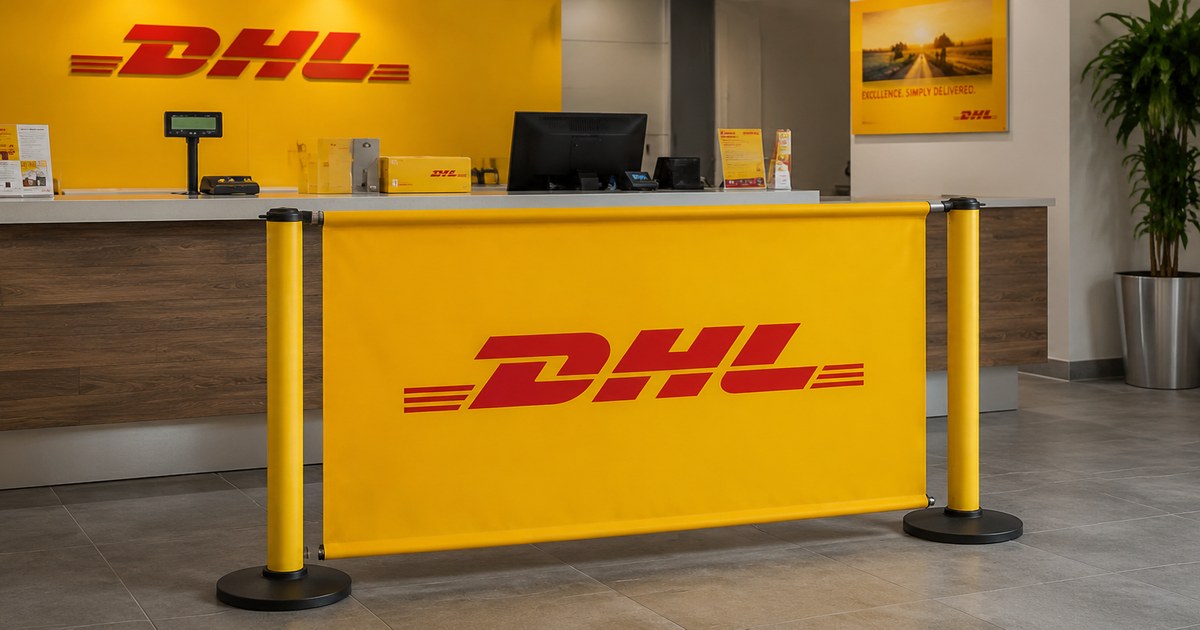 Tips & Advice Custom printed barriers: divide your space and show your brand A free-standing barrier with a banner in your colours: divide and communicate in a single move. Uses, personalisation…
  Our ranges in detail Which base for your barrier post? The 6 bases compared Weighted, magnetic, stackable, fixed or removable: the comparison of the 6 barrier post bases.
 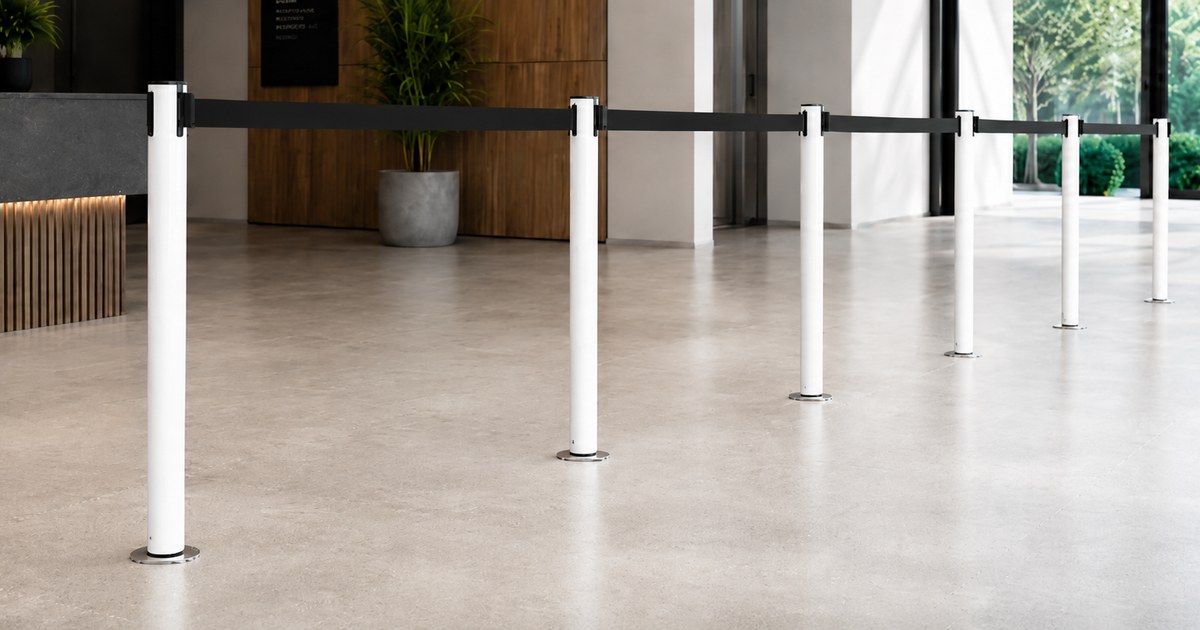 Tips & Advice Removable socketed barrier post: fixed anchoring, mobile freedom A recessed, discreet anchor you remove at will to free the floor: all about the removable socketed barrier post.
 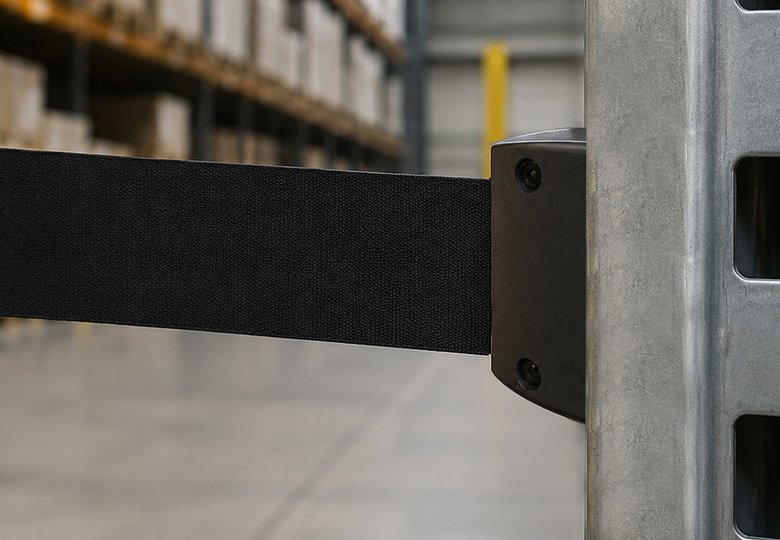 Tips & Advice Strap End: What is the Purpose of Each Finishing Type for Guidance Posts? Standard, security, magnetic or anti-panic: discover the purpose of each strap end for crowd control posts and why…
  Tips & Advice Post Cap with Strap: Standard, White Label or Customised? Standard, white label or bespoke: the three cap finishes for Potelet® strap posts and how to choose yours.
  Tips & Advice For personalising the straps on your crowd control posts, insist on textile sublimation! Explanation. Personalise your crowd control post straps with textile sublimation for a professional and durable finish!
  Customisation How to personalise your post strap? Complete configurator guide Discover how to create your personalised strap in 7 steps: RAL colour, HD logo, front/back printing. Our free online configurator for your…