Branding & guidanceQueue Sponsorship: Get Your Partners to Fund Your Barrier Posts
Your visitors wait with their eyes on a belt at hand height. That space has a value. A partner can pay for it, and your barrier posts stop costing you anything.
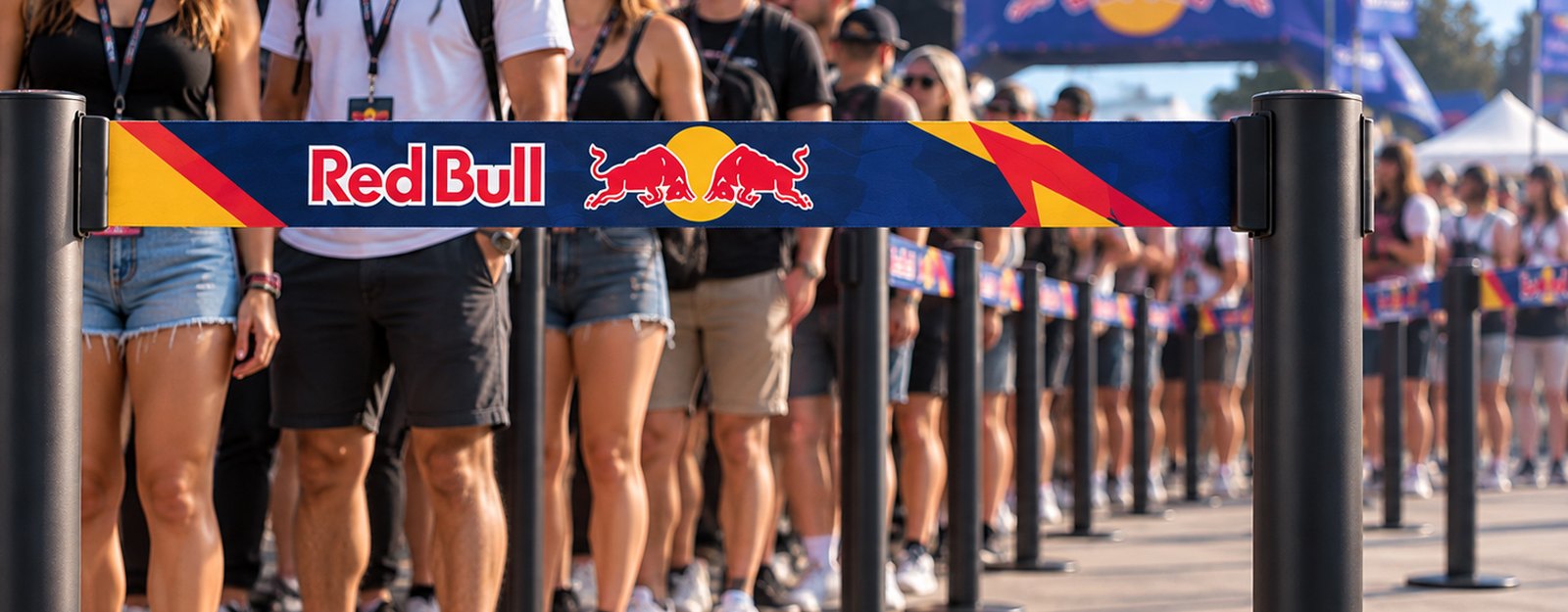
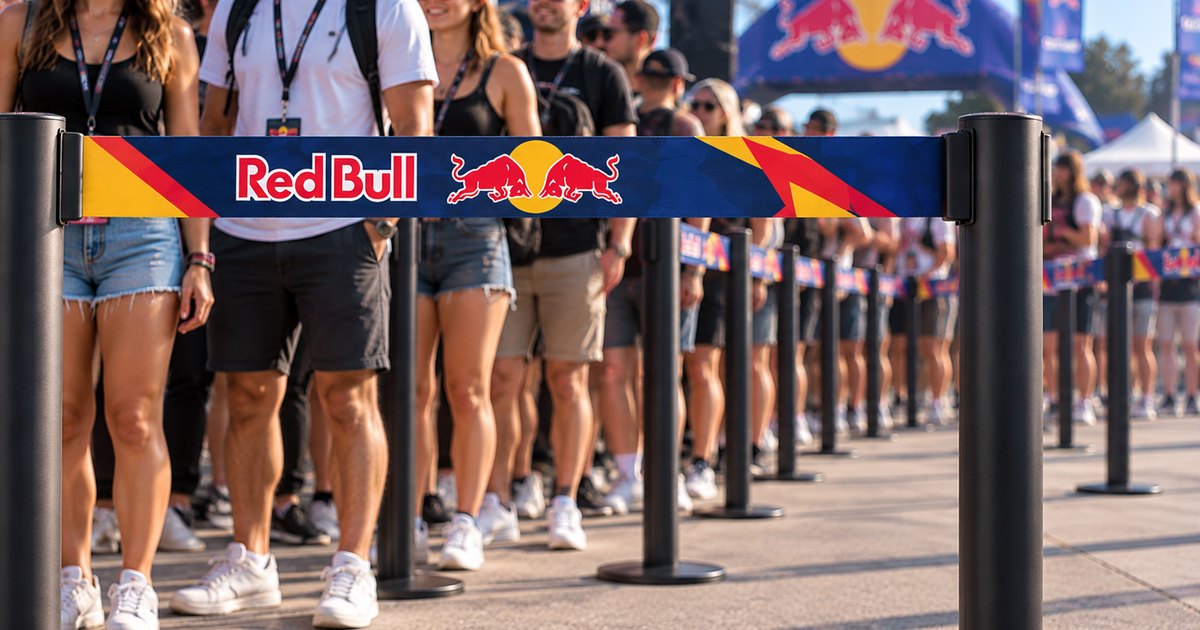
A stadium, trade show, museum or shopping centre buys its barrier posts the way it buys fire extinguishers: a compulsory expense, invisible, with no return. Yet every metre of belt stretched in front of a till or an entrance sits exactly where hundreds of people stop, wait and look. Queue sponsorship means handing that space to a partner: they print their message on the belt of a customised belt barrier post and, in return, fund all or part of the equipment. The venue manages its flows better, the partner reaches a captive audience, and the bill changes hands.
The queue: an advertising space almost nobody uses
Advertising looks everywhere for seconds of attention. A queue offers minutes. The visitor is standing still, available, often with eyes at belt level: it runs at hand height, less than a metre away, and repeats from post to post along the whole route. No screen to switch on, no poster to hang: the medium is already in place, it just needs printing.
It is also a space that cannot be ignored. People walk round a poster and look away from a screen, but they follow the belt: it tells them where to go. Message and route become one, which gives it a reading rate that no other medium in a reception area can match. Big names have understood this for years in airports and stadiums; the idea works just as well for a regional fair or a municipal museum.
Key point: a printed belt is not a signage cost, it is a media placement: captive audience, long exposure time, repetition along the whole route, impossible to ignore because it is the thing that guides.
Three ways to get your barrier posts funded
The partner pays for belts in their name
The simplest model. The venue owns or buys its posts; the partner pays for a set of belts printed in their colours for an agreed period. The investment stays modest for both sides, and the venue keeps neutral, reusable equipment when the campaign ends.
The partner funds the posts and the belts
For new equipment or an extension (a new ticket hall, a refurbished lobby, a food court), the partner funds the posts themselves in exchange for exclusive presence on the belts for one or more seasons. The venue is equipped without touching its budget, and the partner gets lasting visibility at a strategic spot. When the contract ends, the posts stay where they are: you simply change the belts.
Co-branding: venue and partner together
The belt carries your identity on one side and the partner's on the other, or alternates the two logos along its length. Double-sided textile sublimation printing makes this natural: the visitor coming in sees one message, the one leaving sees another. It is the favourite formula at trade shows and events, where the organiser wants to stay visible while showcasing its sponsors.
Who can benefit?
Stadiums, arenas and live venues
Entrances, ticket checks, bars and shops: queues are long and recur at every event. A brewer, a kit supplier or an official partner finds a concentrated audience there, in a festive mood when people are receptive. The club gains one more sponsorship package to offer, without adding a single sign inside the ground.
Trade shows, exhibitions and conferences
Reception and registration are the compulsory passage for every visitor. The organiser can reserve the belts for a premium exhibitor or an official sponsor, and change beneficiary at each edition. On the stands themselves, an exhibitor can use their own printed belt to extend their visual identity, next to a custom printed advertising barrier carrying the main message.
Museums, exhibitions and visitor attractions
Ticket desks, cloakrooms, access to temporary exhibitions: the belt can show the patron of an exhibition, a partner foundation or an associated cultural institution. A discreet message, in a colour matched to the scenography, respects the venue while publicly thanking those who fund it.
Airports, stations and transport hubs
These are the longest and busiest queues there are. Banks, insurers, telecom operators and tourist destinations already buy premium advertising space there. The belt of a barrier post completes that offer at the point closest to the traveller, where they wait and cannot walk away.
Shopping centres and retail
Checkout queues, customer service and collection points are the last metres before the purchase. A supplier, a brand stocked on the shelves or a neighbouring retailer can fund your posts there to show an offer, a new product or a simple brand reminder at the moment of decision. Black Friday and the holiday season make this even more valuable.
Events, festivals and sports competitions
Equipment is hired or bought for a few days, queues are dense and sponsors are many. One set of printed belts per sponsor, interchangeable from one zone to another, lets you share the visibility between several partners and reuse the posts the following year.
What a sponsored belt must carry to work
A belt is read on the move, at an angle, on a narrow strip. The rules are those of long-distance display: a single message, a crisp logo, strong contrast between background and text. A logo repeated along the full length remains the safe choice; a short slogan or a web address completes it without overloading it. Avoid long texts and fine graphics, which become unreadable as soon as the belt is pulled taut or tilts.
Background colour is a lever in its own right: an exact match to the partner's brand guidelines, or the venue's colour with the partner's logo set into it. A QR code printed at regular intervals turns waiting into interaction: prize draw, offer to show at the till, event programme, newsletter sign-up. Keep it large enough and well contrasted to be scanned in a single gesture.
On the manufacturing side, textile sublimation fixes the colours into the polyester fibre: the pattern does not flake and withstands thousands of retractions. To design the artwork, the custom belt configurator lets you choose the colour, place the logo and preview the result before production starts.
Tip: ask the partner for a vector file of their logo and their exact colour reference. A belt printed in an approximate shade is the most common complaint from advertisers, and the easiest to avoid.
Change sponsor without changing equipment
The whole economic case for sponsorship rests on one mechanical detail: on a retractable belt barrier post, the belt sits in a belt cassette (reel housing) that can be removed and replaced. You keep the posts and the bases, you swap the cassette, and the message changes with it. The procedure is described in our guide replacing the belt reel housing.
This opens the door to a real calendar: one partner for the sporting season, another for the holiday season, an institutional belt between two campaigns. A venue with several zones can also assign each zone to a different sponsor, then rotate the cassettes. Always keep a set of neutral belts in the venue's colours: it keeps the guidance going between two contracts.
- Seasonal: one belt per season or commercial peak, the partner changes, the posts stay.
- By zone: ticketing, catering, shop, each area has its own sponsor and its own belt.
- By event: one set of cassettes per show, stored and refitted for the next edition.
How to pitch the offer to a partner
A partner buys an audience, not posts. Present the space as you would present any advertising site: who passes, for how long, at what distance, and what they get exclusively. A few steps are enough to build a credible proposal.
- Quantify the audience: footfall in the area over the period, average waiting time, number of posts and metres of belt in view.
- Define the scope: zones covered, duration, sector exclusivity or not, one side only or both sides.
- Set the split: who funds the belts, who funds the posts, who owns the equipment when the contract ends.
- Frame the artwork: venue guidelines to respect, proof approval, artwork supplied as vector files.
- Put it in writing: a short written agreement covering these points avoids any argument when belts are removed or replaced.
The decisive argument for the venue: when the campaign ends, the posts stay. Quality guidance equipment, acquired at no cost, ready for the next partner or for a return to neutral belts.
Which equipment for a sponsored queue?
The LIMIT range is designed for this use: fully customisable retractable belt barrier posts, available in several belt lengths and in plain or coloured finishes, with a replaceable belt cassette.
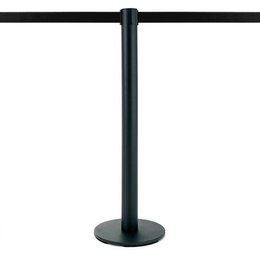
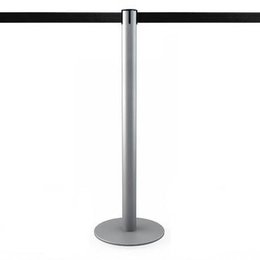
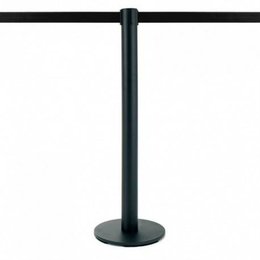
- Retractable belt barrier post, 3 m, black or silver grey: the standard format for indoor queues, discreet, leaving all the space to the belt artwork.
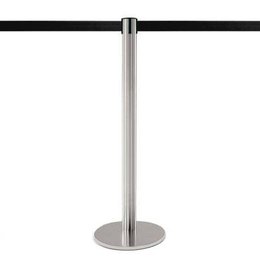
- Brushed stainless steel queue barrier post: the premium finish for lobbies, museums and hotels where the furniture must stay elegant.
- Retractable belt barrier post, 5 m: fewer posts for the same queue length, so less equipment to fund and larger printed areas in one piece.
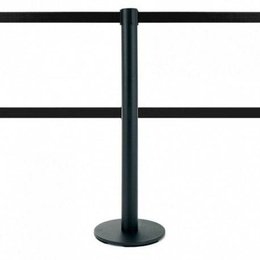
- Double belt barrier post LIMIT DUAL: two belts one above the other, so two messages, or a partner on top and the venue below.
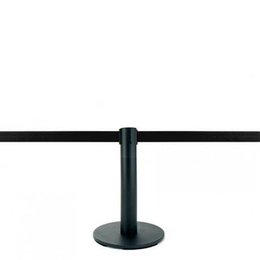
- Mini barrier post LIMIT MINI: the low version for counters, tills and areas where a full-height post would block the view.
For a mixed route, these posts combine with the other retractable belt barrier posts in the catalogue and with advertising barriers at entry points. Custom belts are made in our own workshops, which guarantees a faithful shade and perfect consistency from one set of cassettes to the next.
Frequently asked questions
What exactly is queue sponsorship?
It is an agreement under which a partner funds all or part of your barrier posts in exchange for printing their message on the belts. The venue gets guidance equipment at no cost or at reduced cost, and the partner gets an advertising space facing a captive audience.
Can I change partner without buying new posts?
Yes. The belt sits in a replaceable cassette. You keep the posts and the bases, you swap the cassette, and the message changes with it. A set of neutral belts keeps things running between two contracts.
Which message formats work best on a belt?
A logo repeated along the full length, a short slogan, a web address or a well-contrasted QR code. A belt is read on the move and at an angle: a single, crisp, high-contrast message always works better than a busy design.
Can two brands be printed on the same belt?
Yes. Double-sided printing lets you show the venue on one side and the partner on the other, or alternate the two logos along the length. This is the co-branding formula, widely used at trade shows and events.
Do printed belts withstand intensive use?
Textile sublimation fixes the pattern in the polyester fibre rather than on the surface. The artwork withstands repeated retraction and friction from the mechanism without flaking, which matters for a queue used every day.
What is the difference from an advertising barrier?
An advertising barrier offers a large, solid panel, ideal for a main message at a fixed point. A sponsored belt barrier post accompanies the visitor along the whole queue and can be reconfigured at will. The two complement each other: the barrier announces, the belt accompanies.
In short
A queue is one of the few places where the public is standing still, attentive and less than a metre from a printable surface. Queue sponsorship turns that space into a resource: a partner funds your posts or your belts, you organise your flows at no cost, and the replaceable belt cassette lets you change message, season or partner without touching the equipment. Guidance equipment that, for once, earns money for the venue that installs it.
Discover the LIMIT customised belt barrier posts
Belt printed in your colours or your partner's, replaceable belt cassette, several lengths and finishes.
See the customised belt barrier posts



 Tips & Advice Queue Sponsorship: Get Your Partners to Fund Your Barrier Posts Stadiums, trade shows, museums, airports, shopping centres: the belt on your barrier posts is advertising space that…
 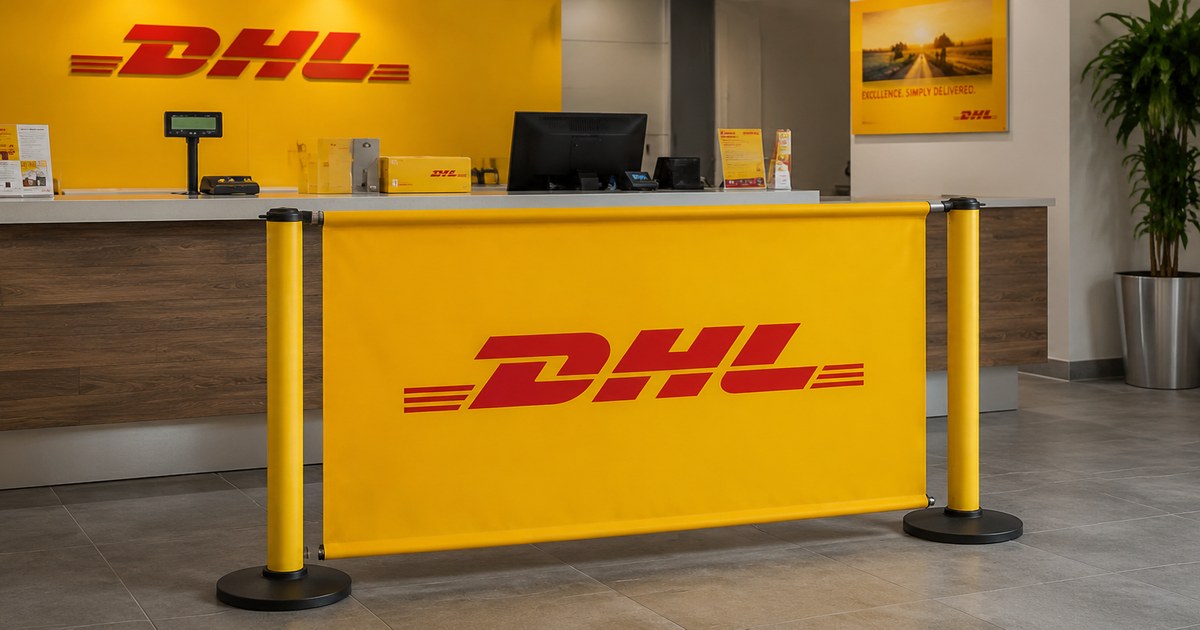 Tips & Advice Custom printed barriers: divide your space and show your brand A free-standing barrier with a banner in your colours: divide and communicate in a single move. Uses, personalisation…
  Our ranges in detail Which base for your barrier post? The 6 bases compared Weighted, magnetic, stackable, fixed or removable: the comparison of the 6 barrier post bases.
  Tips & Advice Removable socketed barrier post: fixed anchoring, mobile freedom A recessed, discreet anchor you remove at will to free the floor: all about the removable socketed barrier post.
  Tips & Advice Strap End: What is the Purpose of Each Finishing Type for Guidance Posts? Standard, security, magnetic or anti-panic: discover the purpose of each strap end for crowd control posts and why…
  Tips & Advice Post Cap with Strap: Standard, White Label or Customised? Standard, white label or bespoke: the three cap finishes for Potelet® strap posts and how to choose yours.
  Tips & Advice For personalising the straps on your crowd control posts, insist on textile sublimation! Explanation. Personalise your crowd control post straps with textile sublimation for a professional and durable finish!
  Customisation How to personalise your post strap? Complete configurator guide Discover how to create your personalised strap in 7 steps: RAL colour, HD logo, front/back printing. Our free online configurator for your…